
 The Standard Group Plc is a multi-media organization with investments in media
platforms spanning newspaper print
operations, television, radio broadcasting, digital and online services. The
Standard Group is recognized as a
leading multi-media house in Kenya with a key influence in matters of national
and international interest.
The Standard Group Plc is a multi-media organization with investments in media
platforms spanning newspaper print
operations, television, radio broadcasting, digital and online services. The
Standard Group is recognized as a
leading multi-media house in Kenya with a key influence in matters of national
and international interest.

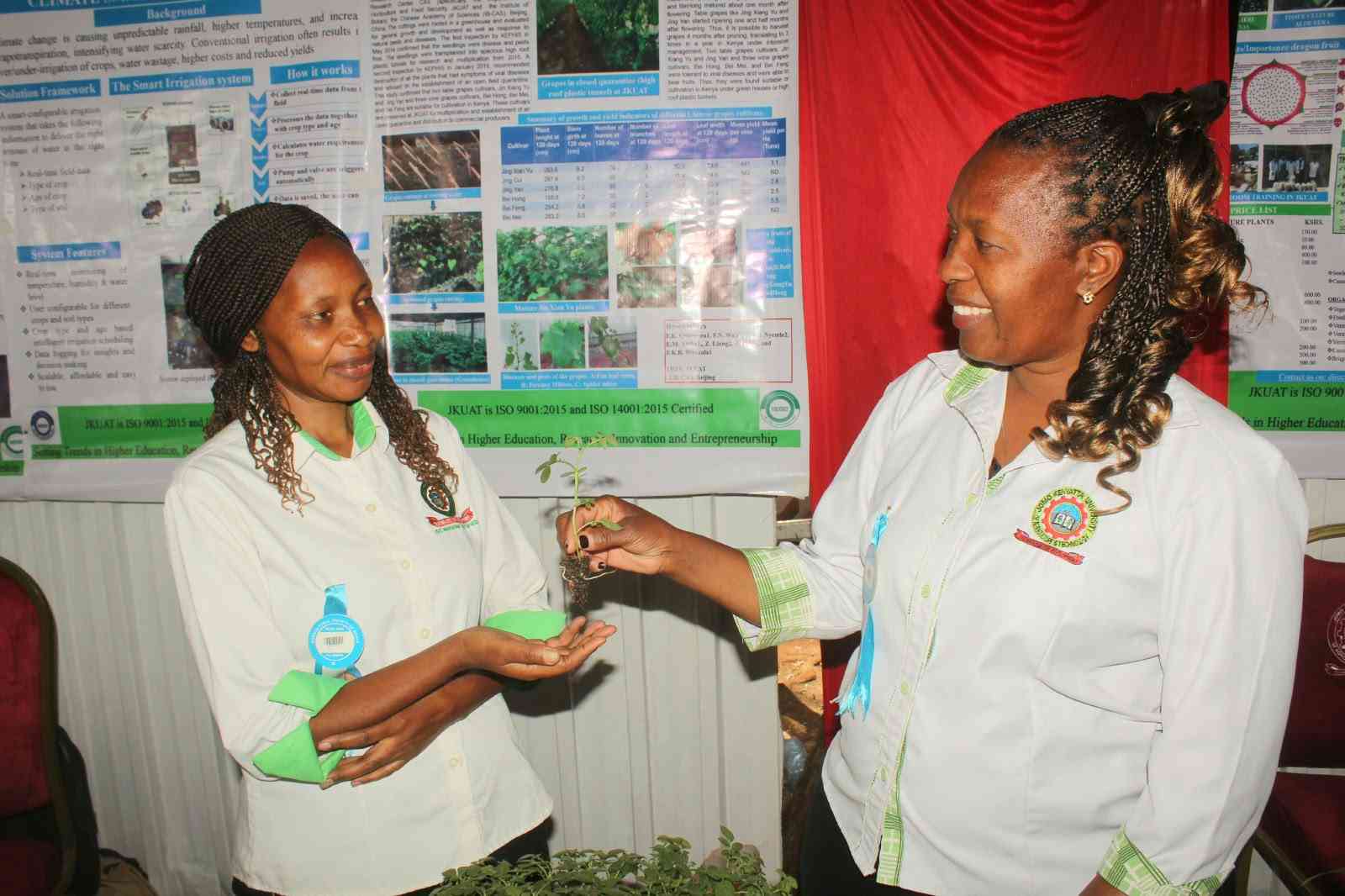
One potato eye can produce up to 10,000 cuttings through tissue culture, while a single plantain tissue can generate about 200 plantlets, researchers at Jomo Kenyatta University of Agriculture and Technology (JKUAT) say.
The technology is being showcased at the Nairobi International Trade Fair at Jamhuri Park Showground in Nairobi, where researchers and students are demonstrating how tissue culture can speed up the production of planting material.
At the JKUAT stand, technical officer Jane Njambi demonstrates how plantain is propagated by taking a single tissue from a sucker and passing it through several stages.
"We are having the plantains for which we are doing tissue culture, whereby we only get a tissue from the sucker — only one tissue, which is this one," Njambi explains.
The tissue goes through initiation and multiplication stages, where it develops into several suckers that can be subdivided before moving to rooting and hardening stages.
"From one tissue, you are likely to get 200," she notes.
Njambi says the process can also reduce the time farmers wait for a crop compared with conventional planting.
"If you compare the normal bananas which we normally plant at the farm, you will find that they take two to three years. But when we are doing this tissue culture, they only take nine months to one year, and then you will be having your fruit," she explains.
The process also allows researchers to produce planting material in large numbers while reducing exposure to pests and diseases.
"Some of the things that make us do tissue culture is because of high yield — you look at this and you will see that the yield is very high. Another advantage is that they are disease- or pest-free. There is also the advantage of mass production," Njambi says.
At the same stand, researcher Dr Grace Mungai demonstrates how tissue culture can be used to multiply Irish potatoes, including the Shangi variety.
Mungai works with Dr Cecilia Mweu, director of the Institute for Biotechnology Research, and Agnes Kavoo of the Horticulture Department.
"We start with an eye. This is the eye of the potato. Just one eye can give us 10,000 cuttings," Mungai says.
She explains that the work aims to increase the supply of clean planting material for potato breeders, who can then multiply the seed for farmers.
"This work we are doing is to promote the multiplication of seeds, because you realize that potato is one of the key plants for eliminating hunger in our country. So our work is now to propagate mass plantlets and cuttings for breeders," she says.
Mungai says the plantlets are free of pests and diseases and can help breeders produce planting material for farmers.
"At the end of the day, the yield is very high because the process has not been interrupted by pests and diseases," she adds.
She also distinguishes tissue culture from genetic modification, saying the process does not alter the genetic makeup of the plants.
"Actually, it is not GMO, because we have not touched the genetic makeup of this plant. All that we have done is take it through a cleaning and multiplication process. This is very different from genetic modification," Mungai explains.
The Nairobi International Trade Fair entered its third day on Wednesday, September 30, with exhibitors showcasing agricultural technologies, products and research.
The fair opened on Monday, September 28, and runs until Sunday, October 4.










 join
join