
 The Standard Group Plc is a multi-media organization with investments in media
platforms spanning newspaper print
operations, television, radio broadcasting, digital and online services. The
Standard Group is recognized as a
leading multi-media house in Kenya with a key influence in matters of national
and international interest.
The Standard Group Plc is a multi-media organization with investments in media
platforms spanning newspaper print
operations, television, radio broadcasting, digital and online services. The
Standard Group is recognized as a
leading multi-media house in Kenya with a key influence in matters of national
and international interest.

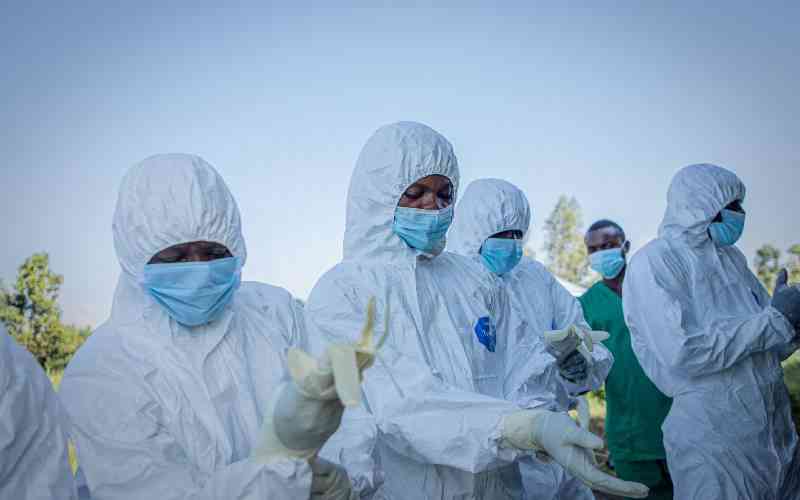
The reporting and sharing of suspected Ebola cases in Kenya have been disrupted for the past week after the Ministry of Health disabled a real-time disease surveillance tool, raising concerns over the country’s ability to monitor potential infections and coordinate its response.
The shutdown of the All Disease Outbreak Module (AdaM), which captures suspected cases, contact-tracing activities, people in quarantine and isolation, and laboratory results, has reportedly limited health officials’ access to updated information on suspected infections.
The disruption comes as Kenya responds to its first fatal case of Ebola Bundibugyo virus disease, reported on Tuesday last week, heightening the need for effective surveillance and timely reporting.
AdaM was disabled on Thursday last week, according to sources familiar with the system, leaving health workers uncertain about the status of suspected cases and the progress of contact tracing.
“People are just frustrated with information back out,” said an insider familiar with the AdaM tool.
"Let us know what is happening. Riht now, even if a case is reported, we cannot know unless they tell us. that cripples alertness," added the source.
- Race Against Ebola: Gavi, CEPI Launch Fast-Track Vaccine Plan for Bundibugyo Strain
- Funding delays threaten Ebola clinical trials
- French Doctor recovers from Ebola as DRC outbreak pushes hospital capacity to 96
- US backs Kenya's Ebola fight with Sh1.9 billion, targets 22 counties
Keep Reading
The Ministry of Health, including Director-General Patrick Amoth, has not responded to questions about the shutdown. Sources said the system was managed through the Director-General’s office.
The ministry has also not addressed concerns raised about patients presenting with symptoms associated with Ebola, including a case at Nanyuki Teaching and Referral Hospital in which a patient reportedly died after presenting with symptoms that raised concern.
A letter from the Laikipia County Government dated October 13 indicated that a female patient was admitted to the hospital on October 12 with a three-week history of general body malaise, fever and an intermittent dry cough.
More than 24 hours before admission, she developed shortness of breath and bleeding from body orifices and puncture sites.
The hospital reportedly confirmed that the patient did not have Ebola but did not provide details of the cause of death. The patient has since been buried.
An official familiar with AdaM said the platform would have captured details of the case and enabled health teams to monitor follow-up tests until the results were available.
“Our hands are tied. We cannot tell cases of people presenting with Ebola, or not. This is how frustrated we are. If the system was working, we could be having details of the patient, and follow-up tests until results are out,” added the official privy to the AdaM system.
“With the move, we expect rumours, because we cannot track the patient,” he added.
“AdaM system enabled us to know suspected cases, but at the moment, we do not know. This continue to breed rumours and uncertainty of the Ebola and other infectious diseases,” the source said.
Contacted for the second time, Dr Amoth did not respond.
Ministry says alternative system is in place
A ministry insider told the Standard that an alternative reporting platform, known as UHAI, had been adopted.
“We have an alternative UHAI which is equally good,” said the insider, who requested anonymity.
However, the source did not provide details on how the platform operates, who can access it, the information it captures or who is responsible for managing it.
Healthcare providers involved in the Ebola response said they had not been informed about the new system or how to use it.
"We Do not know about UHAI. Where is it hosted and who has access," posed a provider. "Because if first responders do not know about it, how is it useful?"
The lack of clarity has raised questions about why AdaM was disabled as the government stepped up surveillance following confirmation of an imported case of Ebola Bundibugyo virus disease.
Sources said the shutdown had complicated coordination, making it difficult for health officials to establish where contact tracing was taking place and what action was being taken.
System used to coordinate outbreak response
Beyond Ebola, AdaM supports the surveillance and reporting of other notifiable diseases, including Mpox.
Established during the Covid-19 pandemic, the platform allows trained health workers to enter information on suspected cases, symptoms, treatment, laboratory tests and results. The data can then be accessed by authorised officials, including those coordinating the response at the national level.
According to insiders, the system has been central to identifying suspected cases and guiding decisions on testing, isolation and contact tracing.
The platform reportedly flagged a suspected Ebola case in Wajir involving a person who had travelled from the Democratic Republic of Congo (DRC), where an outbreak had been reported.
Insiders also said information about the fatal imported Ebola case at Nairobi Hospital appeared on the system before the government publicly announced the case.
One source said officials involved in the response were required to follow established international reporting protocols, including notifying the World Health Organisation (WHO) before making a public announcement.
“We knew about the case, but we cannot break protocol. The system is expected to help in better handling without creating panic, while consolidating all contacts and putting actions in place,” the source said.
The source said the platform was designed to trigger action by response teams as soon as a health worker entered a suspected case, without waiting for separate phone calls or reports.
“The moment I put a case in the system, even before I make a phone call, they are already responding to what is required and looking for contacts,” said the source.
The platform also allowed trained health workers across the country to report cases and enabled national officials to monitor developments in different counties.
“For instance, if a provider is in Garissa, they can see what is happening and where contact tracing is being conducted. For now, we do not know. This was the essence of the system, to ensure smooth coordination and action to prevent further transmission,” added the source.
Only a limited number of health professionals, who received Ebola-related training in June, have access rights to the system, according to sources.
The professionals expressed concern that without timely access to updated information, health workers could struggle to establish the status of suspected cases and determine the appropriate response.
“If they freeze the system, it becomes hard to monitor. We are the implementers,” said a source.
The source warned that restricting access to surveillance information could undermine coordination, particularly when health workers need to establish whether contacts have been identified, tested or placed under monitoring.
Doctors call for clear communication
Meanwhile, the Kenya Medical Practitioners and Dentists Union (KMPDU) has urged the government to improve communication on Ebola preparedness and establish a single channel for sharing information on suspected cases, contact tracing and test results.
KMPDU Deputy Secretary-General Dr Dennis Miskellah said a coordinated communication system was necessary to ensure accurate and timely updates.
“To have confidence, and clarity in Ebola preparedness, we need structured way of communication. If a case is suspected, for example, counties should share the details with Ministry, for reporting,” said Miskellah.
He said separate announcements by county governments, governors and the Ministry of Health risked creating confusion.
The concerns have been illustrated by the handling of suspected cases in Wajir and Laikipia, he said.
In Wajir, police officers announced a suspected Ebola case, while the county government later shared the test results. In Laikipia, the case was announced by Nanyuki Teaching and Referral Hospital acting chief executive officer Dr Sammy Kilonzo.
“The ministry should have strictures. We need a single trusted source where we can get information. There is confusion all over that is not good in handling an emergency,” he said.







 join
join