×

The Standard e-Paper
Read Offline Anywhere
 The Standard Group Plc is a multi-media organization with investments in media
platforms spanning newspaper print operations, television, radio broadcasting,
digital and online services. The Standard Group is recognized as a leading
multi-media house in Kenya with a key influence in matters of national and
international interest.
The Standard Group Plc is a multi-media organization with investments in media
platforms spanning newspaper print operations, television, radio broadcasting,
digital and online services. The Standard Group is recognized as a leading
multi-media house in Kenya with a key influence in matters of national and
international interest.

Audio By Vocalize

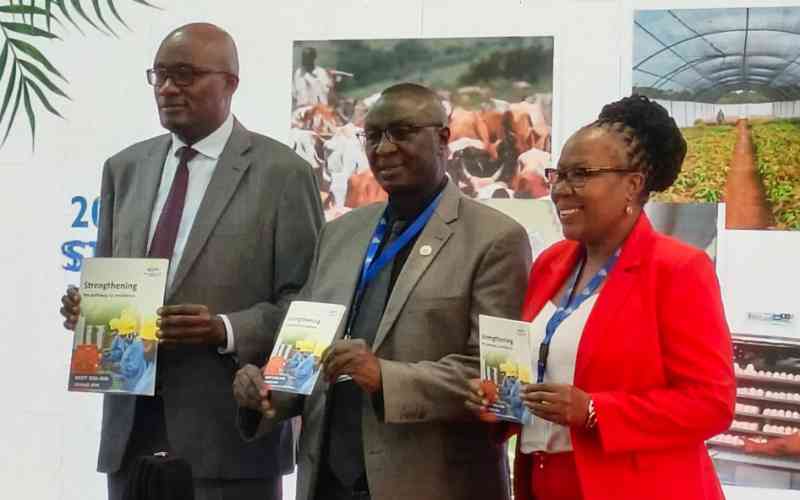
From left: MSEA Chief Executive Officer Henry Rithaa, MESPT Chairman Noah Melly and MESPT CEO Rebecca Amukhoye during a stakeholder forum in Nairobi. [Nanjinia Wamuswa, Standard]
The Micro Enterprises Support Programme Trust (MESPT) has launched its 2026–30 Strategic Plan amid growing pressure to unlock financing and build resilience for Kenya’s struggling micro, small and medium enterprises (MSMEs), particularly in the agriculture sector.
The plan, unveiled at a stakeholder forum in Nairobi, comes at a time when small businesses and farmers are grappling with limited access to credit, volatile markets and the mounting effects of climate change that continue to slow down growth in one of the country’s most critical economic segments.
Micro and Small Enterprises Authority (MSEA) chief executive Henry Rithaa, representing the Cabinet Secretary for Co-operatives and MSMEs Development, acknowledged the scale of the problem, noting that despite their central role in job creation and economic activity, MSMEs remain largely underserved.
“MSMEs are the backbone of our economy, but they continue to face structural barriers, particularly access to affordable finance, markets and the increasing risks associated with climate change,” he said.
The MESPT strategy now seeks to directly respond to these gaps, with a strong emphasis on inclusive agricultural financing and green investment.
Under what it terms as “Pillar One: Inclusive Agri and Green Finance,” the organisation is targeting to expand access to affordable financing for smallholder farmers and agri-based enterprises.
Key interventions include boosting wholesale lending through last-mile financial partners, promoting financial products, and catalysing green investments to support what stakeholders describe as a “just transition” toward climate-resilient agriculture.
The strategy also aims to strengthen institutional capacity among financial partners while mobilising capital to de-risk lending to small enterprises.
If successfully implemented, MESPT projects that by 2030 at least 250,000 farmers will have accessed agricultural and green financing, with more than Sh7.2 billion disbursed through partner institutions. The plan also targets strengthening 100 last-mile financial institutions, increasing agriculture and green loan portfolios by 10 per cent, and creating up to 60,000 jobs.
But even as these targets are unveiled, questions remain about implementation, particularly in a financing landscape where many smallholder farmers and MSMEs still struggle to meet lending requirements.
MESPT chief executive Rebecca Amukhoye acknowledged the challenge, emphasising that the strategy is designed to go beyond traditional financing models.
“This is not just about lending more money,” she said. “It is about building systems that work for smallholder farmers and MSMEs — systems that understand their realities, reduce their risks and connect them to sustainable markets.”
Amukhoye said the organisation’s approach will focus on partnerships, working closely with financial institutions, value chain actors and development partners to ensure that financing reaches the last mile.
Stay informed. Subscribe to our newsletter
“We are deliberately focusing on inclusive and green finance because that is where the future lies, supporting farmers and enterprises to adapt to climate change while still growing their businesses,” she added.
The strategy builds on MESPT’s track record over the past decade, where it has supported value chain development and green financing initiatives across the country.
According to data shared during the launch, the organisation has facilitated over Sh6.5 billion in total sales turnover among targeted smallholder farmers, while also supporting 78 agri-enterprises to strengthen their operational capacity.
In addition, more than 112,000 farmers have been engaged across various value chains, benefiting from improved linkages to input suppliers and output markets.
Earlier interventions have also seen the rollout of green financing models that created over 15,000 jobs and facilitated billions in turnover, alongside programs aimed at strengthening food safety standards and agribusiness capacity across multiple counties.
However, sector players note that while these gains are significant, they remain a fraction of what is needed to fully unlock the potential of Kenya’s MSME sector.
“There is progress, but the gap is still wide,” said one stakeholder at the event. “The real test will be whether this strategy can scale impact and reach farmers and businesses that have traditionally been excluded.”
The launch also highlighted the broader economic context within which the strategy is being implemented. Kenya’s agriculture sector, a key employer and contributor to GDP, continues to face climate shocks, including erratic rainfall and prolonged droughts, which directly affect productivity and incomes.
At the same time, access to affordable credit remains a major constraint. Many MSMEs operate informally and lack the collateral required by traditional financial institutions, making it difficult for them to secure loans.
It is this intersection of financial exclusion and climate vulnerability that MESPT is seeking to address through its new plan.
By strengthening last-mile financial institutions and promoting blended finance models, the organisation hopes to reduce the risks associated with lending to smallholder farmers and MSMEs, while also supporting investment in climate-smart agriculture.
Rithaa pointed to government-backed initiatives such as NYOTA and KJET as complementary efforts that are already helping to bridge some of these gaps, particularly through financing and capacity building.
Still, analysts caution that coordination between public and private sector initiatives will be key to avoiding duplication and ensuring maximum impact.

Subscribe to our newsletter and stay updated on the latest developments and special offers!












 join
join