×

The Standard e-Paper
Home To Bold Columnists
 The Standard Group Plc is a
multi-media organization with investments in media platforms spanning newspaper
print operations, television, radio broadcasting, digital and online services. The
Standard Group is recognized as a leading multi-media house in Kenya with a key
influence in matters of national and international interest.
The Standard Group Plc is a
multi-media organization with investments in media platforms spanning newspaper
print operations, television, radio broadcasting, digital and online services. The
Standard Group is recognized as a leading multi-media house in Kenya with a key
influence in matters of national and international interest.
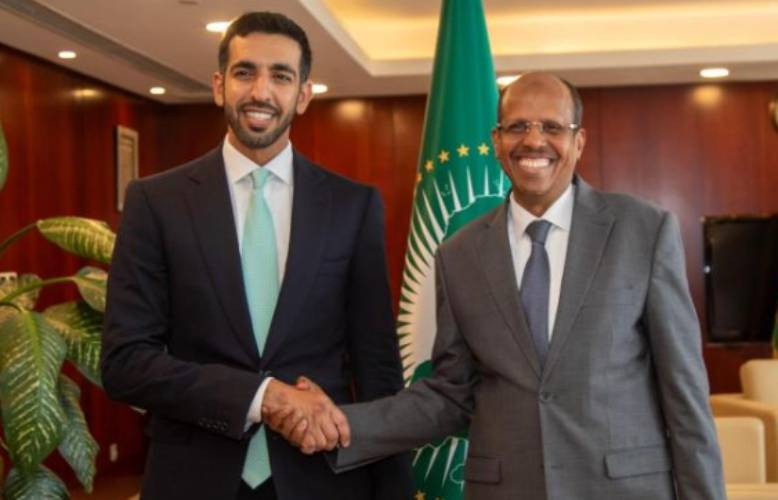
African Union Commission Chairperson Mahmoud Ali Youssouf (left) with United Arab Emirates Minister of State Sheikh Shakhboot bin Nahyan Al Nahyan. [Courtesy]
The United Arab Emirates (UAE) and the African Union Commission (AUC) have agreed to expand cooperation in peace and security, trade, investment and emerging technologies following high-level talks in Addis Ababa.
African Union Commission Chairperson Mahmoud Ali Youssouf and UAE Minister of State Sheikh Shakhboot bin Nahyan Al Nahyan met on January 6, to review progress since their first political consultations in Abu Dhabi in September 2025.
The talks were conducted under a 2019 Memorandum of Understanding (MoU) that established the cooperation framework between the two sides.
The officials focused on Africa's Agenda 2063, particularly the "Silencing the Guns by 2030" initiative, emphasising that peace and security remain foundational to the continent's long-term prosperity.
"Economic integration and development cannot thrive in the absence of stability," the two sides noted, underscoring the close link between increased trade, investment and durable peace.
The implementation of the African Continental Free Trade Area (AfCFTA) featured prominently in the discussions. Both parties argued that inclusive economic growth can help address the root causes of conflict while strengthening regional integration.
The leaders welcomed the UAE's $1 billion "AI for Development" initiative, announced at the G20 Leaders' Summit in Johannesburg in November 2025.
They said the programme could support Africa's development priorities through digital transformation and emerging technologies in education, healthcare and public service delivery.
On regional security, the Horn of Africa dominated discussions, with both sides highlighting the strategic interdependence between stability in the region and security in the Arabian Gulf.
Maritime security emerged as a key concern given its implications for trade routes, regional prosperity and global supply chains.
The situation in Sudan featured strongly in the talks. The UAE and the AUC stressed the urgent need for an immediate and unconditional humanitarian truce, a permanent ceasefire and unrestricted humanitarian access across the country.
They called for accountability for violations of international humanitarian law and reiterated their support for the establishment of an independent, civilian-led government that reflects the aspirations of the Sudanese people.
Both sides reaffirmed their commitment to Sudan's territorial integrity and unity.
On Somalia, the two parties reiterated their continued support for the country's sovereignty, territorial integrity, security and stability, emphasising the importance of sustained international and regional engagement in its state-building and security efforts.
Stay informed. Subscribe to our newsletter
The meeting addressed the UAE's position on the dispute over the islands of Greater Tunb, Lesser Tunb and Abu Musa, which are occupied by Iran.
Both sides expressed support for a peaceful resolution in line with international law, whether through bilateral negotiations or referral to the International Court of Justice (ICJ).
Looking ahead, the officials highlighted the African Union's 2026 theme on water and sanitation and the upcoming 2026 United Nations (UN) Water Conference, to be co-hosted by the UAE and Senegal.
They described the conference as a critical opportunity to advance global action on water resilience, particularly for Africa, and agreed to work closely to deliver practical outcomes.
Initiatives such as the Mohamed bin Zayed Water Initiative were cited as potential vehicles for translating commitments into tangible results.




Subscribe to our newsletter and stay updated on the latest developments and special offers!






 join
join