×

The Standard e-Paper
Home To Bold Columnists
 The Standard Group Plc is a
multi-media organization with investments in media platforms spanning newspaper
print operations, television, radio broadcasting, digital and online services. The
Standard Group is recognized as a leading multi-media house in Kenya with a key
influence in matters of national and international interest.
The Standard Group Plc is a
multi-media organization with investments in media platforms spanning newspaper
print operations, television, radio broadcasting, digital and online services. The
Standard Group is recognized as a leading multi-media house in Kenya with a key
influence in matters of national and international interest.

Audio By Vocalize
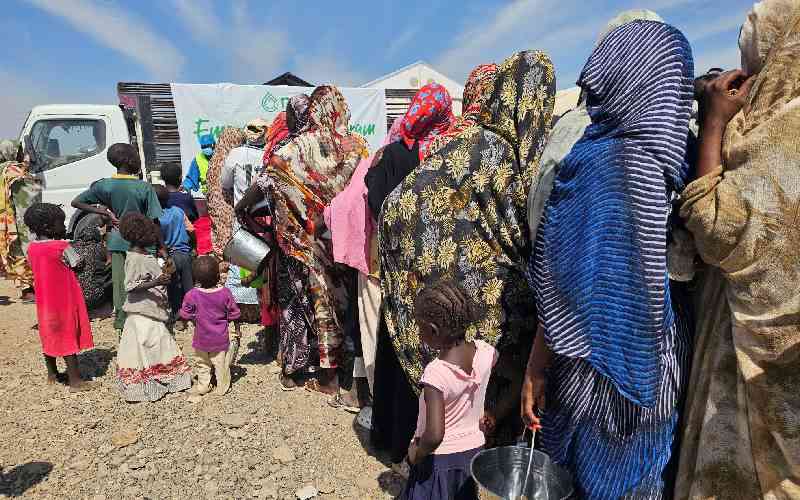
Displaced Sudanese wait to receive humanitarian aid at the Abu al-Naga displacement camp in the Gedaref State, some 420km east of the capital Khartoum on February 6, 2026. [AFP]
The atrocities unleashed on Sudan's El-Fasher last October were a "preventable human rights catastrophe", the UN rights chief said Monday, warning they now risked being repeated in Kordofan.
Giving the UN Human Rights Council an update on the situation in El-Fasher, Volker Turk decried the horrific scenes after the paramilitary Rapid Support Forces (RSF) unleashed a "wave of intense violence", following 18 months of brutal siege.
"Thousands of people were killed in a matter of days, and tens of thousands fled in terror," he said, stressing the need to "hold those responsible accountable, and to make sure this never happens again".
The Sudanese regular army and the RSF have been at war since April 2023, with the conflict killing tens of thousands of people, displacing millions more and triggering one of the world's worst humanitarian crises.
The UN High Commissioner for Human Rights said that during a recent visit to Sudan, he had heard first-hand accounts from survivors of the El-Fasher violence, and had "rarely seen people so traumatised".
"They consistently reported mass killings and summary executions of civilians... both inside the city and as people fled", Turk said.
"Survivors also spoke of seeing piles of dead bodies along roads leading away from El-Fasher, in an apocalyptic scene that one person likened to the Day of Judgment," he said.
He maintained that "sexual violence was systematically used as a weapon of war by the RSF", and said his staff had also documented the recruitment and use of children by the RSF.
Turk said his office's findings were consistent with the International Criminal Court assessment that "both war crimes and crimes against humanity" had taken place in El-Fasher.
Such atrocities were predictable and preventable, he insisted.
His office, he pointed out, had "sounded the alarm about the risk of mass atrocities in the besieged city of El-Fasher for more than a year".
"The threat was clear, but our warnings were ignored," he lamented.
While the RSF was responsible for the atrocities committed in El-Fasher, he insisted that the international community had a responsibility to "do better".
"If we stand by, wringing our hands while armies and armed groups commit well-flagged international crimes, we can only expect worse to come," he warned.
Stay informed. Subscribe to our newsletter
Turk said he was currently "extremely concerned that these violations and abuses may be repeated in the Kordofan region", where fighting has intensified since the capture of El-Fasher, in the neighbouring Darfur region.
Civilians were "at risk of summary executions, sexual violence, arbitrary detention" and family separation, he said.
Turk also voiced particular alarm at repeated drone strikes by both sides.
In just over two weeks leading up to February 6, Turk said his office had documented "some 90 civilians were killed and 142 injured in drone strikes".
The strikes, which were carried out by both the RSF and the Sudanese army, "struck a World Food Programme convoy, markets, health facilities and residential neighbourhoods in South and North Kordofan", he said.
Turk called on "every state to consider what it could have done to prevent the deaths of many thousands of civilians in El-Fasher, and what it will do to prevent a repeat elsewhere in Sudan".
In particular, he called on countries to "press for the arms embargo on Darfur to be extended across the whole of Sudan".
Many diplomats who took the floor during Monday's debate echoed Turk's alarm.
The European Union representative said the bloc was "gravely concerned about the situation in Kordofan and reiterates that the horrors witnessed in El-Fasher must not be repeated".
Algeria's representative agreed, insisting: "We cannot allow another civilian catastrophe to unfold on our watch".
"We are witnessing the very embodiment of cruelty," Switzerland's representative told the council.
"We must not turn away."


Subscribe to our newsletter and stay updated on the latest developments and special offers!






 join
join