Mourning Margaretta Gacheru, mzungu who loved Kenya
Opinion
By
Mulang'o Baraza
| Aug 14, 2024
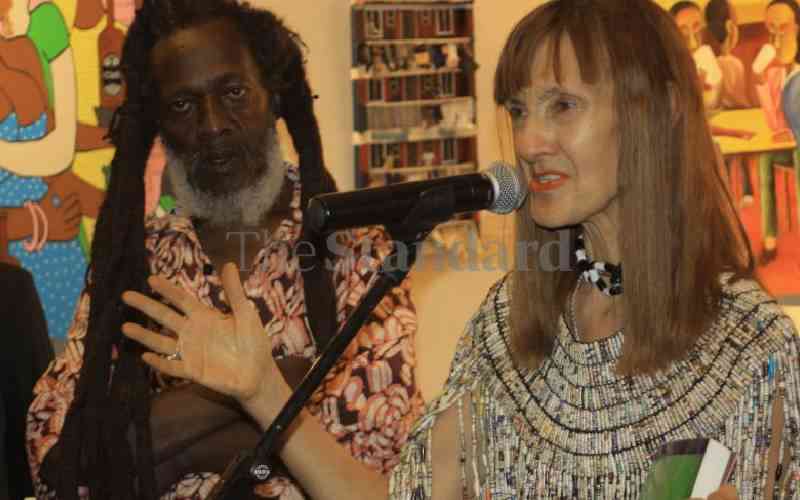
Last year, Zambian writer friends invited me to a literary event in Lusaka. One of them, a man verging on sixty, couldn't stop obsessing about a love affair he'd had with a Kenyan woman he met in Japan in the 2000s.
Kenya, he told me, had long been an oasis of refuge for those in Africa whose home countries' political environments was inimical to free artistic expression. Ngugi wa Thiong'o and John Kiriamiti were some of his favourite writers.
Margaretta Swigert, alias Margaretta wa Gacheru, who died last week, also fell in love with, not just the people of Kenya, but also its cultures, having first come to Kenya as a post-graduate student in the early 1970s.
She held degrees from colleges in both the United States and Kenya, and taught in some of our colleges, including at the Kenya Methodist University's School of Journalism. It wasn't long before she was reporting and writing on events and works involving, and by Kenyan artists. First for Hillary Ng'weno's the Weekly Review, later the Nairobi Times, before joining Nation Media Group publications, Kenya Times, Men Only and The Standard.
In the late 1970s, she met and married a Kenyan man, Gacheru wa Migwi, but divorced in 1982.
READ MORE
Trade CS says litigation, bureaucracy eroding investor confidence
Delivery platforms expand protections, training for African riders
Government directs TBK to ensure compliance with Tea Act
Saccos' Sh40b at risk as regulator warns of foreign aid dependence
Kenya Power on the spot for neglecting off-grid stations
Xi Jinping new book on China's economic rise tapped as development blueprint for Kenya
Galana Kulalu to be gazetted SEZ: Kagwe
How AI can help businesses save millions on manual procurement
Every risk matters: How foresight can save firms before disaster hits
Calls for more funding for education technology startups as financing dips
Over a 50-year period, she attended and wrote about the arts and cultural events that were partly responsible for Kenya's reputational success as a societal brand.
Some have since argued that the reason the author of The Transformation of Contemporary Kenyan Art (1960-2010) was said to be the best at her craft was because she made her own critiquing of our arts and cultural events a commentary aimed at bridging the gap between the qualitative aspirations and preferences of both the artist(e)s and consumers of their works.
To fully own, as well as help this mission, she surrendered herself to the likely unintended consequence of her self-Kenyanisation.
Hers was the story of the tourist who came, became a part of, and led the re-imagining of both the artistic and cultural expression of what she saw and experienced.
In a country where culture, just like politics, is perennially a goad for relational atomisation, Margaretta sought to signpost us in the direction of the artistic and cultural expression that put on display our collective best.
She, like many of us, must have felt that, in addition to our world-beating athletes, Kenya had a lot more to offer that seldom found sufficient expression-and promotion-in our artistic output. Kenya, in her eyes, was a 'child' full of potential who deserved better-one whose growth was assured, yet needed a fillip.
Although she reported and wrote chiefly on events in Nairobi, it wasn't difficult to see 'the face of Kenya' as covered by the corpus of her pen! Nairobi is where one goes to meet Kenya.
Nearly every village in the country has, at some point, been 'represented' here by an ambassador son or daughter 'in search of life'! It's the good karma that this pool of potential represents that Margaretta wa Gacheru sought to depict in her reports and critiques.
The cultural complex and creative energy, the depiction of which she dedicated nearly 50 years of her life to promoting, were, again in her eyes, the undersold crown jewel of magical Kenya.
To her family, friends and readers, I dedicate these words etched into a tombstone in Ireland: Death leaves a heartache no one can heal; love leaves a memory no one can steal. Fare thee well, Mama Migwi!
Mr Baraza is a writer and historian, Nairobi
MOST READ