×

The Standard e-Paper
Join Thousands Daily
 The Standard Group Plc is a
multi-media organization with investments in media platforms spanning newspaper
print operations, television, radio broadcasting, digital and online services. The
Standard Group is recognized as a leading multi-media house in Kenya with a key
influence in matters of national and international interest.
The Standard Group Plc is a
multi-media organization with investments in media platforms spanning newspaper
print operations, television, radio broadcasting, digital and online services. The
Standard Group is recognized as a leading multi-media house in Kenya with a key
influence in matters of national and international interest.

Audio By Vocalize
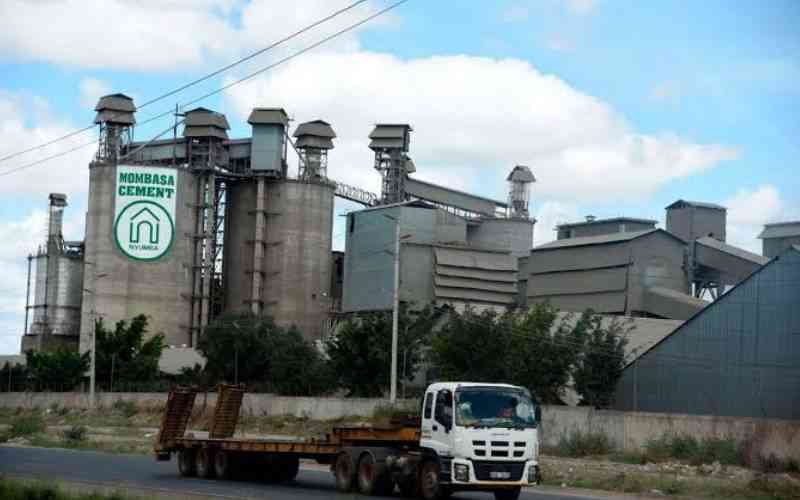
The High Court has ordered Kenindia Assurance Company to pay Mombasa Cement Sh4,216,836,801 in an insurance claim and accrued interest for its collapsed silo and loss of profits since 2012.
Justice Njoki Mwangi directed the Insurance company to pay the said funds comprising Sh664,767,843 for loss of blending silo and Sh982,434,033.00 for loss of profit, both covered under the Machinery Insurance Policy.
The court agreed that the proximate cause of the collapsed silo consisted of defects in materials, faulty design, faults in erection, poor workmanship and lack of skill, all of which constituted insured perils under the Machinery Insurance Policy.
“In light of the foregoing, this Court is persuaded that the plaintiff (Mombasa Cement) proved its material damage loss in the sum of Sh664,767,843.00 and its loss of profits claim in the sum of Sh982,434,033, making the total recoverable loss Sh1,647,201,876,” said Justice Mwangi.
Mombasa Cement owner, the late billionaire and philanthropist Hasmukh K. Patel, had undertaken a one-year insurance policy worth sh.3 billion with Kenindia Assurance Company, which covered machines and equipment, machinery breakdown, loss of profits and various other insurance covers for its plant in Mombasa.
The said policy covered the plant from December 31 2010 to December 31 2011.
However, when the blending silo collapsed on August 1 2011, Kenindia declined to pay the Sh1,647,201,876 claim for the reconstruction of the silo, arguing it was never covered under the Machinery Insurance Policy.
Kenindia said that the replacement value of the insured property was underinsured by approximately Sh3.669 billion, against the insured value of Sh3 billion, resulting in a ratio of 81.76 per cent.
Kenindia ultimately admitted part of the claim and assessed its liability at Sh393,018,965 against the Sh1,647,201,876 claimed by Mombasa Cement.
However, Patel declined to accept the Sh393,018,965, maintaining that the said equipment supplied by Thyssenkrupp India Pvt Ltd cost Sh1,599,897,750.
Patel said that by virtue of the said Policies, Kenindia Assurance undertook to indemnify and pay the plaintiff up to a maximum sum of Sh3 billion under the Machinery Insurance Policy for machinery damage and Sh1.062 billion for loss of profits following the Machinery Breakdown Policy.
He said that if its property was destroyed, Kenindia would pay the actual value for them immediately before the occurrence of the loss, including charges of ordinary freight, cost of erection and customs duties.
Further, the insurer had agreed to pay for any normal charges for dismounting of the machinery destroyed, but the value of the salvage would be taken into account.
Patel said that had the indemnity been paid promptly, reconstruction of the blending silo would have commenced earlier and the interruption period would have been substantially reduced.
He said that following the collapse of the silo, they were made to pay additional premiums of Sh9,040,500 under the Machinery Insurance Policy and Sh3,733,727 under the Loss of Profits Policy.
Stay informed. Subscribe to our newsletter
The Director said that he was compelled to fund reconstruction from its own resources while simultaneously pursuing the insurance claim.
Patel said that reinstatement of the blending silo took two years to demolish, redesign, procure, reconstruct, install and recommission the industrial facility.
In her judgement dated August 12, 2026, Justice Mwangi said that the blending silo was insured under the Machinery Insurance Policy.
The judge ruled that Mombasa Cement is entitled to be indemnified both under the Machinery Insurance Policy and the Loss of Profits, following the Machinery Breakdown Insurance Policy.
Justice Mwangi said that the collapse of the blending silo resulted from insured perils and not from causes excluded under the Machinery Insurance Policy.
The judge noted that earlier interim assessments prepared by Kenindia’s own experts quantified the loss at substantially higher amounts before the position that the blending silo was not insured was adopted by the said experts.
The judge further said that the Loss of Profits Insurance Cover was intended to indemnify the plaintiff against business interruption arising from machinery breakdown.
“The evidence adduced shows that the collapse of the blending silo interrupted operations at the clinker plant and caused cessation of production and consequent loss of profits. Due to the said circumstances, this Court is satisfied that interruption of business and operations was
directly attributable to the insured event,” said Justice Njoki.
The judge noted that extensive investigations were undertaken by numerous Experts and Loss Adjusters, including McLarens Young International Ltd, Milind Bhatawadekar, Development Consultants International Limited, Construction Diagnostic Centre and Toplis and Harding International Limited.
On 31st December 2011, the Broker lodged a claim with the defendant for the loss of USD 15,446,757.00 (Sh1,213,974,345), which included a claim for the cost of the silo equipment, local fabrication at site, blending silo construction, strengthening of other structures, cost of clearing debris and other civil foundations, excluding the loss of profits claim.
Mombasa Cement said that an independent valuation of the total losses by Toplis & Harding International Limited assessed its loss for Machinery as Sh664,765,843.00 and Loss of Profits as Sh982,434,033.00, giving a total loss of Sh1,647,199,876.00.
However, Kenindia appointed Loss Adjusters, including Milind Bhatawadekar and McLarens
Young International Ltd, who assessed material damage at Sh506,104,904 and business interruption loss at Sh221,337,175, giving a gross assessment of Sh727,442,079.
Kenindia Legal Officer Irene Owiti said that investigations revealed that the blending silo was a large reinforced concrete structure constructed on site and therefore constituted civil works rather than machinery.





Subscribe to our newsletter and stay updated on the latest developments and special offers!






 join
join