×

The Standard e-Paper
Kenya’s Boldest Voice
 The Standard Group Plc is a
multi-media organization with investments in media platforms spanning newspaper
print operations, television, radio broadcasting, digital and online services. The
Standard Group is recognized as a leading multi-media house in Kenya with a key
influence in matters of national and international interest.
The Standard Group Plc is a
multi-media organization with investments in media platforms spanning newspaper
print operations, television, radio broadcasting, digital and online services. The
Standard Group is recognized as a leading multi-media house in Kenya with a key
influence in matters of national and international interest.

Audio By Vocalize
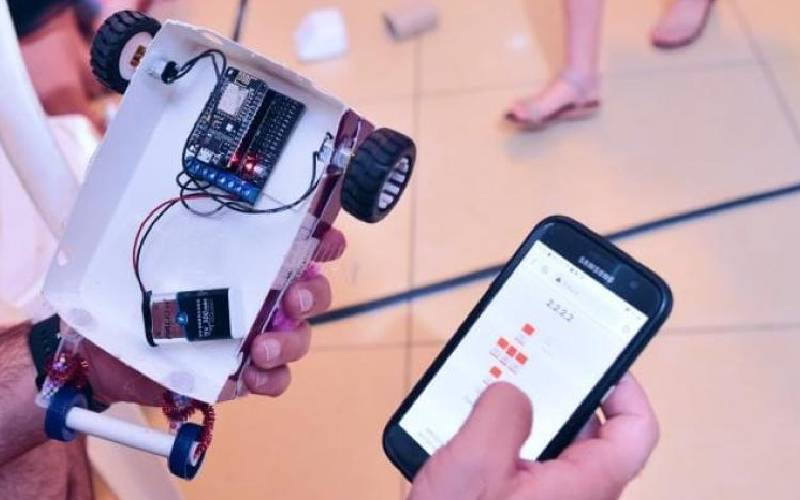
On the third floor of the Daisy Centre, a school situated along the Bukura-Butere Road, is a 50-seater, fully equipped computer lab.
There are more than 50 laptops and desktops, a projector, and a large screen. Huddled together in the centre row is a group of students ranging from Grade Four to Nine studying various aspects of computer language.
In the adjacent room, learners concentrate on a prototype robotic car that they have been building and are halfway through with it. This undertaking has made Daisy stand out as a pioneer in robotics.
“In the simplest terms, robotics is the science and engineering of designing, building, and operating machines that can carry out tasks automatically or semi-automatically,” explained Harrison Shikuku, the ICT and computer science teacher at Daisy.
These machines, or robots, can be as simple as a toy car that stops when it hits a wall, or more advanced and complicated robotic arms used in hospital theatres to perform operations with precision.
“Robotics draws from disciplines such as mechanical engineering (to build the body and moving parts), electronics and electrical engineering (to power the systems), computer science (to give the robot instructions), and artificial intelligence (to allow the robot to learn and make decisions). A robot is, in essence, a physical machine brought to life by code,” Shikuku says.
Shikuku uses the example of a calculator that only does what you press. A robot, on the other hand, can be told in advance what to do in a variety of situations and do it on its own.
While a majority of schools, especially public schools, are still struggling with the basics of digital literacy, Daisy Centre’s students are already at an advanced stage of making an Obstacle Avoiding Vehicle (OAV), a miniature robot that uses sensors to detect thermal heat and navigate around objects in its path without any human guidance. It is the kind of technology that powers self-driving cars, industrial machinery, and medical robots in hospitals around the world.
“The OAV that my students are building, for instance, has sensors that ‘see’ the heat radiating from objects in its environment and instruct its wheels to steer away before it collides. No human hand is required,” Shikuku says.
Globally, robotics is being embraced to solve some of humanity’s most pressing problems, especially in manufacturing products faster and more affordably, exploring environments too dangerous for humans, like deep-sea missions, collapsed buildings, or outer space.
They are instrumental in improving healthcare delivery and boosting agricultural productivity.
The International Federation of Robotics estimates that there are now over 3.5 million industrial robots operating in factories worldwide, with that number growing every year.
“At the heart of every robot is a programme, which is just a set of instructions written in a computer language that tells the machine what to do, when to do it, and how to respond to its environment,” Shikuku says.
Programming, also called coding, is essentially writing in a language the computer understands. Just as English has grammar and vocabulary, programming languages like Python, Scratch, C++, and Java have their own rules and syntax.
A simple command might tell a robot, “If the sensor detects an object within 20 centimetres, turn left.”
Stay informed. Subscribe to our newsletter
To a human, that is a straightforward instruction. To a robot, it is a line of code that must be written precisely, no spelling mistakes, no missing punctuation. Learning to program teaches children how to interact with technology and to think logically, break down complex problems into smaller steps, and find solutions through structured reasoning.
“Robotics is good for critical thinking,” says Shikuku. “When a child has to figure out why their robot is not doing what they programmed it to do, they are learning how to analyse, troubleshoot, and think independently.”
Despite its obvious benefits, robotics is not part of Kenya’s Competency-Based Education (CBE) curriculum. Public schools under the CBC framework are offered only pre-technical training, foundational skills in basic technology and design, but nothing approaching the hands-on, applied science of robotics.
The difference, educators argue, lies in the learning itself. In robotics, learners put into practice what they see. It is not theoretical knowledge absorbed from a textbook and reproduced on an exam paper. It is applied and immediate. A student writes a line of code, watches the machine respond or fails to respond, and adjusts accordingly. The learning loop is fast and engaging.
This experiential approach in learning is what education and technology advocates have been calling for. Yet the national curriculum, still finding its footing amid the contentious rollout of the CBC, has not caught up.
Unfortunately, only a few can undertake robotics. “Robotics is expensive, which is why public schools are not able to undertake it,” says Shikuku. “A single kit for building an OAV costs between Sh85,000 and Sh110,000.”
For public schools operating on shoestring budgets, many of which cannot even afford enough textbooks or chalk, that figure is simply out of reach.
Given the ongoing confusion in the education sector, public schools can hardly afford this. The rollout of the CBE has stretched school budgets and government resources thin.
Teachers have been retrained, syllabi overhauled, and assessment systems redesigned, all at enormous cost. In that environment, investing in robotics kits that cost the equivalent of several months’ salary for a junior teacher is not a priority for the government.
“Private schools and academies like Daisy Centre, which charge higher fees and attract more resources, are filling the gap,” says Shikuku.
This, however, widens the divide between children from well-to-do families and the poor. The former get access to skills that will define employment and innovation in the 21st century, while those from lower-income households are left behind.
“Beyond the hardware and the code, robotics has documented benefits for students’ broader development,” Head teacher Francis Kadima says.
This is backed by research, which consistently shows that children who engage in robotics education demonstrate stronger problem-solving abilities, improved mathematical reasoning, and greater confidence in tackling unfamiliar challenges.
“Because robotics projects typically require collaboration, one student might design the chassis while another writes the code. Learners also develop teamwork, communication, and project management skills,” Kadima observes
For girls studying robotics, early exposure has been shown to challenge gender stereotypes around technology and engineering, creating pathways into fields that have historically been male-dominated.
At Daisy Centre, girls and boys work side by side on their OAV builds, with no distinction made between them. There is also something to be said for the motivational power of building something that actually works.
In an era where many students struggle to see the relevance of what they learn in school to their real lives, having a robot you built yourself navigate a table without falling off is a demonstration of the connection between knowledge and application.
“Robotics is not just about building OAVs; it can open career pathways. Among the professions that a young Kenyan trained in robotics and programming could pursue are: robotics engineer, software developer and programmer, artificial intelligence (AI) specialist, mechatronics engineer, and data scientist.
Others are embedded systems engineers, drone technicians, and cybersecurity analysts, among others.
Activities at Daisy ICT hub provide a glimpse of what Kenyan education could look like if the will and the resources could be found to make it possible for every child to be ICT literate.








Subscribe to our newsletter and stay updated on the latest developments and special offers!







 join
join