×

The Standard e-Paper
Stay Informed, Even Offline
 The Standard Group Plc is a
multi-media organization with investments in media platforms spanning newspaper
print operations, television, radio broadcasting, digital and online services. The
Standard Group is recognized as a leading multi-media house in Kenya with a key
influence in matters of national and international interest.
The Standard Group Plc is a
multi-media organization with investments in media platforms spanning newspaper
print operations, television, radio broadcasting, digital and online services. The
Standard Group is recognized as a leading multi-media house in Kenya with a key
influence in matters of national and international interest.

Audio By Vocalize
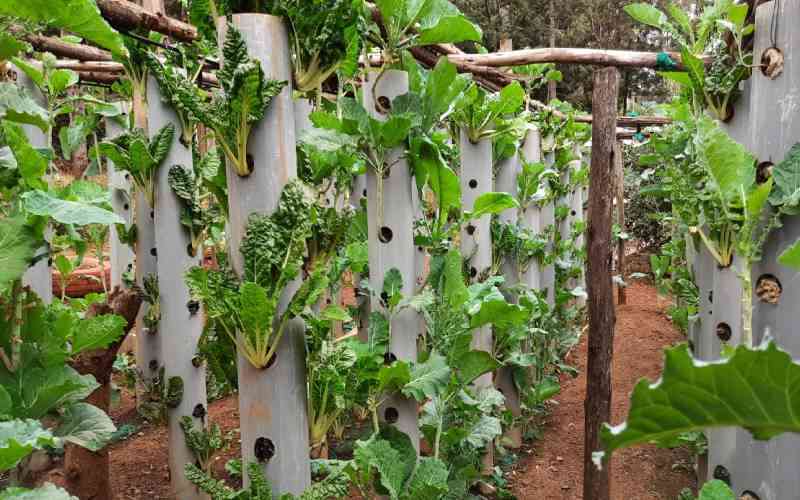
For years, vegetable farming in Isiolo has largely been associated with access to land and reliable water, two resources that many households can scarcely afford.
In a county where water is limited, rainfall is increasingly unpredictable and prolonged dry spells are becoming a major concern, many residents who would otherwise grow vegetables at home have been forced to depend on markets for fresh produce.
But a new approach to agriculture is beginning to challenge that reality.
Agricultural experts say households do not necessarily need large farms or abundant water to produce nutritious vegetables. With the right technology and innovative use of available resources, even a small compound, balcony or unused corner of a homestead can be transformed into a productive kitchen garden.
According to a water and agricultural expert, Eng. Grace Mativo, climate-smart agriculture offers one of the practical solutions to the challenges facing smallholder farmers in Isiolo.
Mativo says farmers can combine organic manure with soil and grow vegetables in locally available containers, including plastic containers and discarded vehicle tyres.
The approach allows households to make maximum use of limited spaces while reducing the amount of water required compared with conventional farming.
It also gives a second life to materials that would otherwise become environmental waste.
Old tyres and plastic containers, for instance, can be converted into growing units instead of being left in open spaces where they can contribute to environmental pollution or clog drainage systems.
“Farmers only need the right technology to produce enough and safe food for their families, even when they have limited space and water,” Mativo says.
Her message is finding resonance among farmers visiting a newly established demonstration farm and nursery along the Isiolo-Nanyuki Highway, where practical climate-smart farming technologies are being showcased.
The Blossom Demo Farm and Nursery, owned by Mrs Winfred Kinanu, has opened its doors to farmers from Isiolo, Meru and neighbouring areas, providing them with an opportunity to see and learn how modern farming technologies can be applied in ordinary homesteads.
Rather than simply explaining climate-smart agriculture in theory, the farm allows farmers to see the technologies in operation.
Among the innovations on display is hydroponic farming, including the use of discarded yoghurt containers as growing units.
The demonstration also shows how vegetables can be produced in small spaces using containers and other readily available materials.
Stay informed. Subscribe to our newsletter
For households struggling with limited land, such methods could provide an opportunity to grow vegetables for consumption while potentially generating surplus produce for sale.
Kinanu says the farm was established not only to provide farmers with quality planting materials but also to serve as a practical learning centre where they can acquire knowledge that can be applied in their own farms and homes.
The facility has a wide range of seedlings, including vegetables, spices, fruit trees and other horticultural crops.
“We want farmers to have easy access to quality seedlings while also giving them practical knowledge on modern farming methods that can help them adapt to changing climatic conditions,” Kinanu says.
For farmers in Isiolo and parts of Meru, access to quality seedlings has previously been a challenge.
Some have had to travel long distances to obtain particular varieties of vegetables and horticultural crops, adding transport costs to an already expensive farming venture.
The establishment of the nursery is therefore expected to bring planting materials closer to farmers while reducing the cost and time involved in sourcing them.
Seedlings expert Vincent Aludo says the nursery stocks a wide selection of vegetables, spices and fruit-tree seedlings, giving farmers greater choice depending on their farming needs and market preferences.
He says having different varieties available locally will also make it easier for farmers to experiment with crops that can perform well under the region's climatic conditions.
For seasoned farmer Japheth Micheni, the availability of quality seedlings locally is a major relief.
Micheni says farmers have traditionally spent considerable amounts of money travelling to distant towns in search of quality planting materials, particularly for popular crops such as onions and tomatoes.
“I am among the happiest farmers in this neighbourhood because we will no longer have to travel long distances to look for seedlings, especially for onions and tomatoes,” he says.
But beyond the convenience of accessing seedlings, Micheni believes the demonstration farm could encourage more residents to take up vegetable farming.
For a household with limited land, growing vegetables in containers could mean turning an otherwise unused space into a source of fresh food.
And for farmers with slightly larger plots, technologies such as efficient water use, organic manure and appropriate crop varieties could help them produce more while using fewer resources.
The idea is particularly important in Isiolo, where agriculture is increasingly being forced to adapt to a changing climate.
Climate-smart farming focuses on approaches that can improve productivity while helping farmers cope with challenges such as water scarcity, rising temperatures and unpredictable weather patterns.
Experts say practices such as container farming, hydroponics, use of organic manure, water-efficient production methods and recycling of locally available materials can help households produce vegetables even under difficult conditions.
The benefits extend beyond food production.
Growing vegetables at household level can reduce dependence on purchased produce, improve access to fresh foods and, where surplus production is achieved, provide an additional source of income.
For smallholder farmers, the ability to produce more from less could become increasingly important as climate pressures intensify.
At the Blossom Demo Farm and Nursery, farmers are therefore being encouraged to look beyond traditional perceptions of what farming requires.
The message is simple: limited land and water should not necessarily mean limited food production.
With appropriate technology, creativity and access to quality planting materials, even the smallest spaces can contribute to household food security.
For Isiolo farmers, the demonstration farm represents more than a nursery selling seedlings.
It is becoming a practical classroom where farmers can see, learn and test technologies that could help reshape the way food is produced in a region facing some of the country's toughest climatic and resource challenges.
As climate change continues to redefine farming, such innovations could provide Isiolo households with an opportunity not only to adapt, but to produce more food with fewer resources.







Subscribe to our newsletter and stay updated on the latest developments and special offers!








 join
join