×

The Standard e-Paper
Join Thousands Daily
 The Standard Group Plc is a
multi-media organization with investments in media platforms spanning newspaper
print operations, television, radio broadcasting, digital and online services. The
Standard Group is recognized as a leading multi-media house in Kenya with a key
influence in matters of national and international interest.
The Standard Group Plc is a
multi-media organization with investments in media platforms spanning newspaper
print operations, television, radio broadcasting, digital and online services. The
Standard Group is recognized as a leading multi-media house in Kenya with a key
influence in matters of national and international interest.

Audio By Vocalize
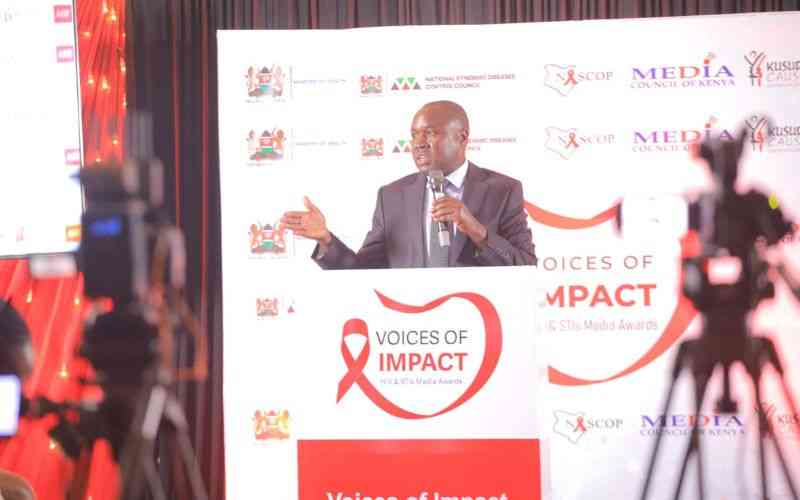
Kenya has made remarkable progress in the fight against HIV/AIDS over the past four decades, but rising infections among young people threaten to reverse some of the gains achieved, the National Syndemic Diseases Control Council (NSDCC) has warned.
According to NSDCC Chief Executive Officer Douglas Bosire, the country's HIV response has transformed dramatically from the dark days of the 1980s and 1990s when an HIV diagnosis was widely perceived as a death sentence.
"It is a fact that the HIV response in this country has evolved and grown tremendously over the last 42 years," Bosire has said.
"In the early years, there was fear, stigma and very little knowledge about the disease. People living with HIV were isolated and discriminated against because many believed infection meant certain death," he added.
Speaking diring the ongoing media wards on HIV dubbed Voices of Impact, HIV and STIs media awards, Bosire has recalled a time when communities distrusted even simple social interactions with people suspected of living with HIV.
Many Kenyans witnessed frequent deaths linked to AIDS-related illnesses, while stigma kept people away from testing and treatment services.
However, through partnerships involving the Government of Kenya, the U.S. President's Emergency Plan for AIDS Relief (PEPFAR), the Global Fund and other development partners, the country has significantly expanded access to testing and treatment.
"Today, we are proud to say that more than 90 per cent of people living with HIV are on treatment," he said.
Through the intervention, rates of new HIV infections have declined from about 94,000 at the peak of the epidemic to approximately 13,000 in 2025.
Despite this progress, Bosire says the country is still missing critical populations, particularly children, adolescents and young adults.
He notes that while prevention of mother-to-child transmission programmes have expanded, antenatal care attendance remains a challenge, with many pregnant women failing to access services early enough to prevent vertical transmission.
"We are not blind to the gaps that still exist. We are losing our children," the CEO has said.
Data from the council shows that young people aged between 15 and 24 years accounted for 41 per cent of all new HIV infections in 2025, highlighting a growing concern among health experts.
"We are having a disproportionately large number of young people getting infected with HIV," Bosire warns
The trend coincides with rising cases of teenage pregnancies across the country. In 2025 alone, Kenya recorded approximately 236,000 pregnancies among girls aged between 10 and 19 years, a reflection of risky sexual behaviour among adolescents.
Stay informed. Subscribe to our newsletter
Bosire attributes part of the problem to declining risk perception among young people, many of whom have never witnessed the devastating impact HIV had on previous generations.
"Young people today have grown up seeing HIV as a manageable condition because treatment is available. Many have never seen someone suffering from AIDS-related illnesses, and therefore do not fully appreciate the risk," he says, adding that HIV was feared as Covid-19 where individuals were locked in secluded places.
Further, Bosire has cited stigma as a major barrier to prevention efforts, saying many people still avoid seeking HIV testing services or purchasing condoms for fear of being judged.
The council has also identified geographical hotspots where significant numbers of people are living with HIV but remain unaware of their status.
Garissa, Mandera, Wajir, Kericho, Busia and Kilifi are among the counties requiring intensified interventions.
At the same time, Bosire called on journalists to help highlight emerging trends in the epidemic, noting that HIV infections are no longer concentrated in traditional hotspots.
“Previously, we focused largely on specific regions, but with changing social and economic dynamics, the epidemic is shifting. We must follow where the infections are occurring and tailor our responses accordingly,” he said.
The NSDCC chief also expressed concern over the burden of HIV among key populations, who continue to record disproportionately high infection rates.
HIV prevalence among people who inject drugs stands at about 9 per cent, while prevalence among transgender persons is estimated at 22 per cent. Men who have sex with men account for 19 per cent, while women who have sex with women account for 23 per cent.
Bosire emphasized that ending AIDS as a public health threat remains achievable if communities, health workers, policymakers and the media work together to reach populations that continue to be left behind.
“It is possible to end AIDS. We know where the gaps are, we know the numbers, and we know the populations that require more attention. What is needed now is sustained commitment and action,” he said.







Subscribe to our newsletter and stay updated on the latest developments and special offers!







 join
join