×

The Standard e-Paper
Fearless, Trusted News
 The Standard Group Plc is a
multi-media organization with investments in media platforms spanning newspaper
print operations, television, radio broadcasting, digital and online services. The
Standard Group is recognized as a leading multi-media house in Kenya with a key
influence in matters of national and international interest.
The Standard Group Plc is a
multi-media organization with investments in media platforms spanning newspaper
print operations, television, radio broadcasting, digital and online services. The
Standard Group is recognized as a leading multi-media house in Kenya with a key
influence in matters of national and international interest.

Audio By Vocalize

Muslim faithful during Eid Ul-Adha prayers at Tononoka Grounds in Mombasa County, on May 27, 2026. [Kelvin Karani, Standard]
Muslims across the country thronged places of worship to celebrate Eid-ul-Adha, the “festival of sacrifice”, with calls for the de-escalation of ethnic rhetoric dominating political campaigns.
They also raised concerns over the high cost of living, the fuel prices, negative effects of the proposed Finance Bill 2026 and inflammatory statements by politicians.
Muslims thronged mosques and open fields for prayers, after which a sermon exhorting prophet Ibrahim’s virtues and the need to share meals with the less fortunate was given.
After the sermons they dispersed to carry out ‘udhia’ (slaughtering of sacrificial animals), which were to be subdivided into three segments — for the poor, neighbours and homestead.
Eid-ul-Adha honours Prophet Ibrahim’s willingness to sacrifice his son as an act of obedience to God, who later provided a ram.
Although some Muslims decried that the hard economic times had dampened the celebrations, others celebrated in style, inviting friends, less fortunate, and relatives to feast together.
In Malindi, Muslim leaders cautioned politicians against making inciteful statements that might create insecurity in the country ahead of the 2027 General Election.
Speaking after attending prayers at Masjid Barawa, the leaders led by Suleiman Salim and Famau Mohamed said that recent outbursts and political egocentrism were a recipe for chaos.
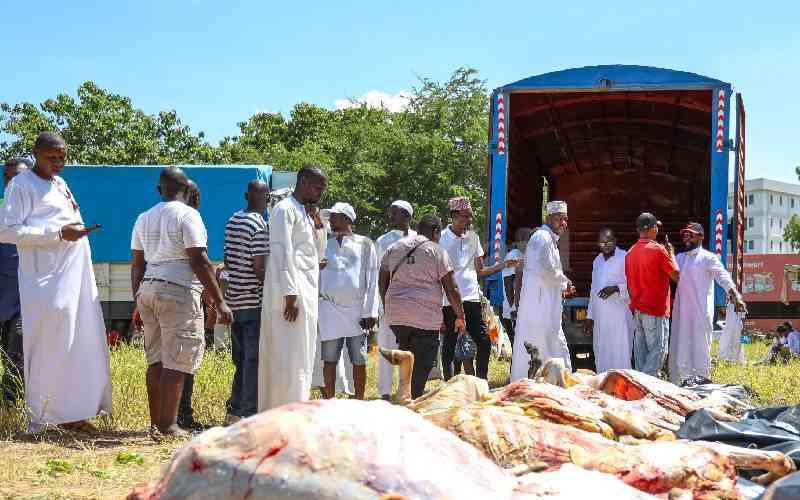
Muslim youths slaughter animals during Eid al-Adha celebrations in Mombasa on May 27, 2026. [Omondi Onyango, Standard]
In Mombasa, Mining Cabinet Secretary Hassan Joho urged Kenyans to embrace unity and sacrifice in their different spheres of life.
“Life is about sacrifice, not selfish but good acts for others, neighbours, and country,” he said, giving an analogy of Prophet Ibrahim’s willingness to sacrifice his son, Ismail.
In Western, the National Chairman of the Council of Imams and Preachers of Kenya, Sheikh Abdalla Ateka, urged the government and MPs to protect Kenyans from the rising cost of living.
He said taxes on fuel should be scrapped in order to ease the cost of transport and reduce pressure on low-income earners.
Stay informed. Subscribe to our newsletter
In Homa Bay, Muslim leaders challenged government agencies to take punitive measures against politicians who perpetrate hatred that may plunge Kenya into electoral chaos.
Speaking at the Kendu Bay Show Ground the leaders called on the Independent Electoral and Boundaries Commission and the National Cohesion and Integration Commission to collaborate in punishing politicians who are dividing Kenyans through hatred.
Muslims during Eid ul-Adha prayers at Menengai High School grounds in Nakuru City, on May 27, 2026. [Kipsang Joseph, Standard]

In Kisumu, Muslim leaders also urged politicians and Kenyans at large to embrace peaceful rhetoric, mutual respect, and responsible political conduct.
Kisumu Muslim Association Chairman Sheikh Musa cautioned against inflammatory statements and insults, saying rising cases of hate speech and divisive rhetoric were dangerous to the country.
“Insulting others or spreading hate speech breeds hostility. We must weigh our words carefully before speaking because words have the power to cause deep harm,” said Musa.
Bahari wi Nam Secretary General Omar Ali urged politicians across the country to conduct campaigns responsibly and avoid incitement that could create tension
Migori Muslim Development Community chairman Omar Ibrahim Zam Zam told Kenyans to calm down, saying the fuel problem did not affect the country alone.
“Kenyans need to calm down.
‘‘They need to understand that the ongoing situation (high fuel prices) is a world problem,” Ibrahim Zam Zam said.







Subscribe to our newsletter and stay updated on the latest developments and special offers!








 join
join