×

The Standard e-Paper
Home To Bold Columnists
 The Standard Group Plc is a
multi-media organization with investments in media platforms spanning newspaper
print operations, television, radio broadcasting, digital and online services. The
Standard Group is recognized as a leading multi-media house in Kenya with a key
influence in matters of national and international interest.
The Standard Group Plc is a
multi-media organization with investments in media platforms spanning newspaper
print operations, television, radio broadcasting, digital and online services. The
Standard Group is recognized as a leading multi-media house in Kenya with a key
influence in matters of national and international interest.

Audio By Vocalize

Kenya could learn from Iowa’s farming methods and improved seeds to boost maize yields and tackle food shortages. [Courtesy]
In 2025, the average maize (corn, as Americans call it) yield in the United States was 186 bushels per acre, according to the United States Department of Agriculture (USDA), Kenya’s equivalent of the Ministry of Agriculture.
A joint survey by the Kenya Agricultural and Livestock Research Organisation (KALRO) and the Ministry of Agriculture (MoA) in December 2025 showed Kenya’s average yield that year was 22 bags, each weighing 90kg.
An American bushel is approximately 25.40kg. Per acre, American farmers therefore produced 4,724kg, while their Kenyan counterparts managed 1,980kg.
While the US average was 186 bushels per acre, Iowa – the Midwestern state known as the ‘King of Corn’ – averaged 210 bushels per acre.
Iowa covers 144,660 square kilometres, compared with Kenya’s 580,367 square kilometres. Yet it produced 2.77 billion bushels (70.4 billion kilograms) of maize in 2025, against Kenya’s 73 million bags (6.6 billion kilograms). To say that Iowa farmers have mastered the art of farming maize would be an understatement.
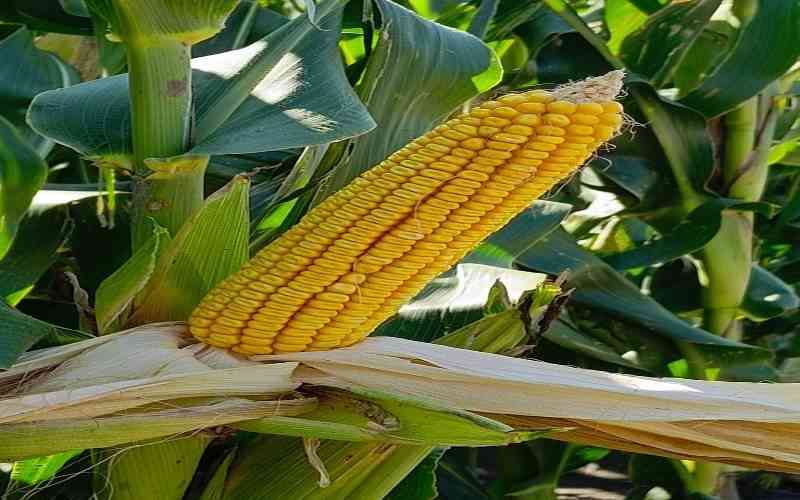
Kenya could learn from Iowa’s farming methods and improved seeds to boost maize yields. [Courtesy]
With Kenya facing dwindling maize production because of unfavourable weather, our farmers could use lessons from Iowans.
Last week, the MoA predicted a production shortfall of nearly 25 million bags in 2026. The ministry is preparing to import the same number to avert famine.
A few days ago, Uasin Gishu Governor Jonathan Bii warned farmers that the country is facing about a 60 per cent reduction in food production, “especially maize”, blaming climate change.
Uasin Gishu lies in the North Rift, Kenya’s breadbasket, largely because of its maize production. Like Iowa, it has fertile soils and generally favourable weather. But that is not enough for bumper harvests on Iowa’s scale.
The average Kenyan farmer is a subsistence farmer, managing a few acres under maize. In Iowa, the average farmer has 345 acres under the crop.
“Machinery technology – although important – is not the way to improve production in one or two hectares,” says Mark Mueller, president of the Iowa Corn Growers Association (ICGA). “That’s not affordable: you need a lot more land than that.”
His suggestion is biotechnology. “It doesn’t depend on farm size.”
I met Mueller and ICGA members on August 19 at the association’s offices, on the outskirts of Des Moines – Iowa’s capital.
Stay informed. Subscribe to our newsletter
Indeed, Mueller explained: “Not long ago we had aeroplanes flying every year to spray against the European corn borer. The bug was a menace. We haven’t had to spray for corn borer in over 25 years. That has saved us money. Through biotechnology, you can control weeds or pests.”
His colleague, Paula Ellis, grows maize and soybeans with her husband. She said: “Those weeds will take away from our corn yields because they’re fighting for those same nutrients that the corn plant is. In a dry year, that weed is soaking up just as much water as the corn plant.” Biotechnology, they reckon, has helped address low-yielding seed.
Driving away from Des Moines, the cornfields appear as a sea of green stretching towards the horizon. The secret, Mueller says, is not simply good soils and favourable weather.
Since the nineteenth century, US maize breeders have sought better-yielding varieties. Many notable names contributed to maize improvement, but none is as prominent as Henry A. Wallace.
Wallace, it is said, began experimenting with maize as a teenager. In 1913, he began producing maize hybrids. In 1924, his new hybrid, Copper Cross – a cross between two open-pollinated varieties – won the Iowa State Corn Yield Test.
On April 20, 1926, Wallace formed Pioneer Hi-Bred Corn Co. The company, now owned by Corteva Agriscience, produced hybrids that contributed to higher yields, including the much-famed Pioneer Seeds embraced by Kenyan farmers.
Initially, Iowa farmers were reluctant to adopt hybrids. By 1935, only 6 per cent of Iowa’s maize acres were planted with hybrids. Higher production helped drive adoption; by 1942, almost all Iowa maize farms were planting hybrid seeds. About 20 years later, hybrid maize had been adopted across the US.
“Now, you’re alluding to farmers not wanting to buy from seed companies,” says Mueller. “Farmers used to grow their own seed, but hybrid corn is the main reason that we were able to get the yield increases. If you were to take something from us, biotechnology is how you make farmers more profitable.”
Indeed, around the 1930s, US farmers produced 26 bushels per acre. The 2025 yield of 186 bushels per acre dwarfs that figure.
In 2023, Virginia farmer David Hula set a world record with 623.84 bushels per acre using a hybrid variety, showing there is a lot of room for improvement even for Iowa farmers.
As for Iowa farmers, they continue to strive towards better yields. And why wouldn’t they?
gchacha@standardmedia.co.ke






Subscribe to our newsletter and stay updated on the latest developments and special offers!








 join
join