×

The Standard e-Paper
Fearless, Trusted News
 The Standard Group Plc is a
multi-media organization with investments in media platforms spanning newspaper
print operations, television, radio broadcasting, digital and online services. The
Standard Group is recognized as a leading multi-media house in Kenya with a key
influence in matters of national and international interest.
The Standard Group Plc is a
multi-media organization with investments in media platforms spanning newspaper
print operations, television, radio broadcasting, digital and online services. The
Standard Group is recognized as a leading multi-media house in Kenya with a key
influence in matters of national and international interest.

Audio By Vocalize

President William Ruto, India's President Droupadi Murmu and Prime Minister Narenda Modi. [File, Standard]
India (Bharat) and Kenya are tied at the hip through history and, lately, economics. India is also closer geographically, making it a potential key trade and investment partner. We trade more with countries closer to us and bigger, says the gravity theory of trade.
Bharat is the official Sanskrit and Hindi name for the Republic of India.
The partnership on the economic front is supported by data. India High Commission to Kenya notes, “India is Kenya’s third largest trading partner with bilateral trade of $4.31 billion (Sh560 billion) for the financial year 2025-26. Indian exports to Kenya amounted to $4.01 billion (Sh521.3 billion), while imports from Kenya to India were $290 million (Sh37.7 billion).” Never mind the trade imbalance.
The missing link is that Kenya has not fully leveraged Indian proximity and economic power.
There are good reasons why we need to focus more on India despite the fact that she does not have the same publicity as other economic powers.
India is a low-lying but ripe economic fruit. Read on and economically salivate.
Let us start with India’s dream, Viksit Bharat 2047 or Vision 2047 whose overarching vision is “to transform India into a developed entity characterised by economic prosperity, social advancement, environmental sustainability, and effective governance.” India or Bharat will celebrate the 100th anniversary of her uhuru in 2027.
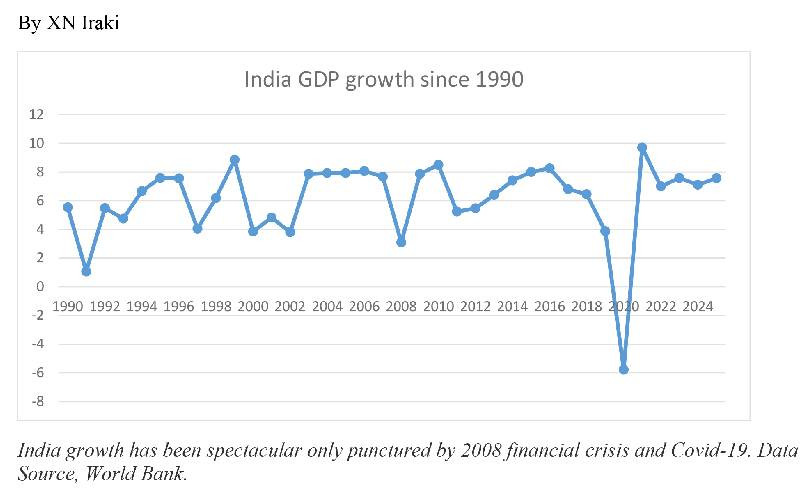
Can we borrow something for our Vision 2063? Let us get down to Earth. Beyond proximity, India’s large domestic market and growing middle class should be a big magnet.
The middle class has the purchasing power and skills. Investors and exporters should be smiling. Add the large population, 1.4 billion, and a fast-growing economy; more will join the middle class and create demand for goods and services.
India’s strength in services, information technology and business-process industries has a global reputation. That has led to offshoring by global firms. But India has developed global firms itself.
Think of Infosys and Tata. Indian computer scientists have a reputation that touches even Silicon Valley. Is this sector ready for AI? Who has not heard of Bengaluru (Bangalore)?
India’s medical services are well known to Kenyans who visit the country for medical procedures. Check where your drugs are made next time you visit a pharmacy. Remember Bollywood?
India has expanded manufacturing, infrastructure and logistics. This has been the cornerstone of the Modi regime. 160 airports in 10 years and more highways and rail.
Stay informed. Subscribe to our newsletter
Connect the population; you catalyse growth through higher productivity. Often forgotten, make it easier to share ideas and catalyse innovation.
Digital public infrastructure and rapid financial inclusion are another hallmark of the Indian economy. Unified Payments Interface (UPI), a universal payment system that mimics our M-Pesa, has been a huge success.
Entrepreneurship, startups and innovation drive the subcontinent. Below the big Indian firms like Tata or Reliance is a big informal sector. That makes it a great place to test new ideas.
The large market and the middle class make scaling up easy. Remember, India is famous for frugal innovations or jugaad, which use minimum resources to cater for local needs. Think of a three-wheeler, the tuktuk or Bajaj motorbikes.
Domestic savings, investment and institutional capacity are the other strengths of the Indian economy. Charity starts at home. Domestic savings make it easy for entrepreneurs to borrow money for startup or expansion.
One of the key pillars of many countries is strong institutions. That is why India is a successful democracy with 1.4 billion people. Managing such a democracy is a phenomenal success.
Economic reforms and greater integration with global markets are the key to India's rise. We have seen the reach of Indian firms and services globally.
First-generation reforms targeted deregulation, tariff reduction, macroeconomic stabilisation, and industrial opening starting from around 1990.
Second-generation reforms emphasised structural market adjustments, public sector disinvestments, fiscal consolidation, and physical infrastructure expansion.
Third-generation reforms focused on digital public infrastructure, tax integration, manufacturing competitiveness, and formalising the unorganised economy. Can we be bold enough to institute such reforms in Kenya?
The Indian diaspora’s role in capital, technology and global networks. With a presence in major countries in the world as entrepreneurs, scholars and corporate leaders, the Indian diaspora has brought home skills, technology and new thinking.
They have raised Indian science, technology, and manufacturing to global standards. Do you recall the Mahindra of the 1990s? Seen the new one? Our diaspora should go beyond remittances.
Strategic autonomy and diversified economic partnerships have driven the Indian economy further.
India is one of the few countries that refuses foreign aid in case of a disaster and was one of the founders of the Non-Aligned Movement.
Today India economic partnerships are diversified, east to west, north to south. Kenya closely mirrors this strategy, but we are too inward-looking.
Indian reforms have worked as indicated by quality and inclusive economic growth, falling poverty rates and rising confidence.
Nilachal Mishra of KPMG India summarises, “As India develops, the quality and inclusiveness of growth will matter as much as its pace” That applies to any other country. There is no doubt India is rising; why not rise together, bound by the Indian Ocean and British colonial legacy?
Subscribe to our newsletter and stay updated on the latest developments and special offers!







 join
join