
 The Standard Group Plc is a multi-media organization with investments in media
platforms spanning newspaper print
operations, television, radio broadcasting, digital and online services. The
Standard Group is recognized as a
leading multi-media house in Kenya with a key influence in matters of national
and international interest.
The Standard Group Plc is a multi-media organization with investments in media
platforms spanning newspaper print
operations, television, radio broadcasting, digital and online services. The
Standard Group is recognized as a
leading multi-media house in Kenya with a key influence in matters of national
and international interest.

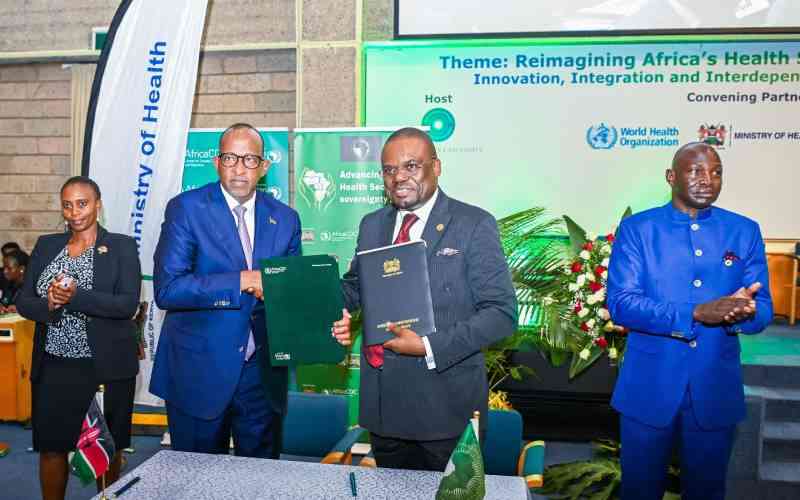
Kenya signs deal to host regional health centre in Nairobi, boosting its role in East Africa’s health security. [File Courtesy]
Africa CDC is set to mobilise ministers from member states to engage the US government over delays in signing the Government-to-Government (G2G) framework, which has slowed implementation of the agreement.This comes as Ghana becomes the latest country to reject a bilateral health deal with the US, citing concerns over terms requiring the sharing of sensitive data, an issue that has delayed actualisation of the deal.Data and pathogen sharing remain key sticking points in the negotiations across the continent that has heavily depended on donors to run its health programs.Kenya's move to have the deal has also stalled, following a court case on data and sovereignty.In an interview with The Standard at the just concluded World Health Summit, Regional Meeting, 2026, Africa CDC Jean Kaseya said efforts are on to have states meet with the US to get a solution on the matter.Kaseya revealed that he led the negotiation with the US government to start a program that gives money directly to governments, instead of using NGOs and other partners.This led to the G2G health bilateral agreement, where states are required to co-finance, instead of fully depending on the donor."We started with each country agreeing, depending on their needs. We need agreement and stop information, with all African ministers, Africa CDC to discuss this," said Kaseya.Both countries that have signed the bilateral agreement, and those planning to sign, shall participate in the scheduled meeting with the US government.However, along the way, Kaseya states discovered that there were components on data sharing and pathogen sharing that had resulted in laxity in signing the agreement."We need to understand more. We need to keep the evidence and stop misinformation. Now we have agreed with the US to organise a big meeting for all African ministers, and Us government, African CaDC to discuss this issue," emphasised Kaseya.In the case of Kenya, where the deal was contested in court, the official maintained that the country is democratic, with laws, and that if the judge of the Supreme Court decided to conduct a specific action, that should be respected."We need to respect that I also know that we are patiently waiting for the outcome, the outcome verdict shall be out. For now, what I know is that the government of Kenya highly respect the supreme court," said Kaseya.But Kaseya maintained the need to allocate more domestic resources in running the health program, and avoiding inefficiencies.President of the World Health Summit (WHS) Prof Axel Pries, on his part, said changes in health funding should be a wake-up call for states."We all have a wakeup call. After a wakeup call, you are awake and have senses. Looking at everything, does it fit into the requirement and wherever the solution must fit the bill," said the official during a media briefing at the World Health Summit Regional Meeting, 2026.Prof Pries maintained that data is key, and it should be protected at any cost."Data is a currency; you have to be really careful when you have it. This data has to be fair, otherwise we will get into a big problem," said Prof Pries.He added, "Knowledge is power, and data and knowledge are power."At least 32 nations have signed the US bilateral health agreements.These include Kenya, Angola, Bolivia, Botswana, Burkina Faso, Burundi, Cambodia, Cameroon, Côte d'Ivoire, Democratic Republic of Congo, Dominican Republic, El Salvador, Eswatini, Ethiopia, Guatemala and Guinea.Other countries include Honduras, Lesotho, Liberia, Madagascar, Malawi, Mozambique, Niger, Nigeria, Panama, Papua New Guinea, the Philippines, Rwanda, Senegal, Sierra Leone, Tajikistan, and Uganda.But several countries have disputed the agreement, namely Kenya, Zimbabwe and Zambia.The US has allocated more than $200 billion (Sh25.8 trillion) into global health since 2001.However, the new approach, which seeks to link health funding to access to strategic minerals and pathogen data, is facing its stiffest test on the continent.In Zambia, negotiations on a health Memorandum of Understanding stalled after the US reportedly linked a billion-dollar grant to access to the country's copper and cobalt reserves.The deal, scheduled for signing last December, hit a snag just four days before the ceremony."We want to leverage US assistance to bring about reforms that will unleash business investment that enhances US access to critical supply chains," said Caleb Orr, US Assistant Secretary of State for Economic, Energy, and Business Affairs, announcing the proposed minerals-for-aid swap.In Zambia, the government requested revisions to the agreement, which reportedly saw the US commitment drop from $1.5 billion (Sh193.5 billion) to $1.012 billion (Sh130.5 billion).A leaked draft also revealed demands for Zambia to share data on pandemic-potential pathogens for 25 years.Elsewhere in Zimbabwe, it was reported that the President directly ordered a halt to negotiations on a $367 million (Sh47.3 billion) health deal.In a leaked letter, Zimbabwe's Secretary for Foreign Affairs, Albert Chimbindi, instructed officials to "discontinue any negotiations with the USA," describing the proposed MOU as "clearly lopsided" and an affront to the nation's sovereignty."Zimbabwe was being asked to share its biological resources and data over an extended period, with no corresponding guarantee of access to any medical innovation, such as vaccines, diagnostics, or treatments that might result from that shared data," explained Nick Mangwana, the government's spokesman.The official that accepting a bilateral arrangement that bypasses multilateral mechanisms would undermine the solidarity African nations have been advocating for on the global stage.Kenya was the first country to sign its five-year cooperation framework, valued at $2.5 billion (Sh325 billion).Under the bilateral government-to-government arrangement, the US was to provide $1.6 billion (Sh206 billion), while Kenya was expected to raise $850 million (Sh109 billion) through a co-financing model.But actualisation of the deal has since stalled following a court case.The deal was suspended following a court case challenging the framework, citing data-sharing and national sovereignty concerns, and a lack of public participation.Petitioners, including Busia Senator Okiya Omtatah, argue the deal could expose citizens to privacy violations, stigma, and misuse of sensitive health information.Kenya's Health Cabinet Secretary Adan Duale maintained that the deal is not being implemented.“The ministry is preparing a road map for its implementation,” he said, adding that it will be implemented only after the conclusion of the court case.The CS said the data issue in the deal shall come into force in the third year of the framework.“The court case is on data sharing, which is coming into force in the third year.”Chargé d'Affaires at the United States Embassy in Kenya, Susan Burns, maintained that the decision lies with Kenyans.
"This is a Kenyan matter. You have an independent court and judiciary system, and you have to follow the rules," Ms Burns said during a tour of Nyeri. "It is up to Kenyans to decide whether they want this funding and how they want it implemented."The delay has split opinion among Kenyan health stakeholders. Health economist Beatrice Kairu defended the judicial intervention, arguing it affirms constitutional governance.
Facts First
This story continues on The Standard INSiDER. Subscribe now for unfiltered journalism that holds power to account.
Already have an account? Login








 join
join