
 The Standard Group Plc is a multi-media organization with investments in media
platforms spanning newspaper print
operations, television, radio broadcasting, digital and online services. The
Standard Group is recognized as a
leading multi-media house in Kenya with a key influence in matters of national
and international interest.
The Standard Group Plc is a multi-media organization with investments in media
platforms spanning newspaper print
operations, television, radio broadcasting, digital and online services. The
Standard Group is recognized as a
leading multi-media house in Kenya with a key influence in matters of national
and international interest.

Relieving ourselves is as natural a process as it gets. Yet, by the time we are adults, pooping becomes shrouded in negative emotions such as disgust. This, in turn, presses upon it a secrecy that keeps us tight-lipped about it.
Have you ever been curious as to what constitutes a healthy bowel movement?
In her book, ‘You’ve Been Pooping All Wrong: How to Make Your Bowel Movements a Joy,’ Dr. Trisha Pasricha, an American Gastroenterologist, explains that a good bowel movement can be judged on the basis of three Ps: propulsion, pliability and pelvic floor.
She defines propulsion as the internal, voluntary pressure, accompanied by involuntary or induced contractions, that eventually push stool through the rectum and then outward.
Propulsion, she writes, is greatly aided by the ‘Valsalva maneuver’: when we create pressure down our abdomen after taking the position that allows one to offload. Doing the Valsalva maneuver when ‘contractions’ are detected is how one optimizes the propulsion factor, Pasricha told CNN earlier in the year.
The second P, pliability, refers to the smooth consistency, or softness, of the stool, which, the doctor says, influences how easily it can be expelled from the body.
Stool pliability is influenced by eating and water consumption habits. The unofficial advice is that we should drink 8 glasses, or 2 litres, of water per day. However, many experts largely agree that we don’t need any more than the amount the body thirsts for.
Dr Pasricha says stool needs sufficient hydration; not just for ease of expulsion but also for ease of movement through the intestines. One should include, in their diet, water-rich foods such as fruits, vegetables and soups. Nutritionists also strongly recommend a diet high in fibre.
- Calls for dialogue on food and water safety over Lake Nakuru fish saga
- Toxic chemicals threatening Kenya's children, women
Keep Reading
The last P is pelvic floor: the set of muscles that stretches from the pubic bone to the tailbone, holds all of your insides together, and assists with functions involved in pooping, peeing and sex.
Dr Pasricha gives the following analogy: Imagine trying to squeeze toothpaste out of its tube, but you don’t take the cap off. The cap is the pelvic floor.
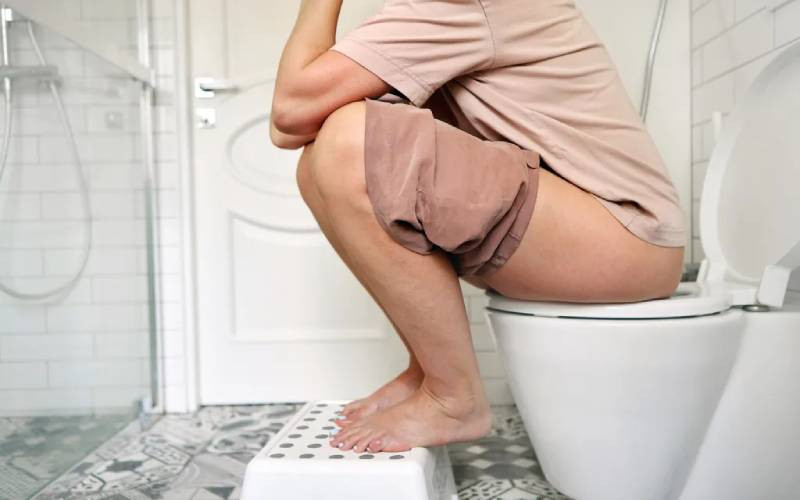
The colon exits through the pelvic floor. A key method for keeping the pelvic floor in top shape for pooping is to keep the knees above the waist while doing the deed, Dr Pasricha writes in her book. This position allows the puborectalis muscle, which is responsible for keeping poop inside, to fully relax. This is why squatting has for centuries been the normal position through which humans in many cultures around the world relieve themselves.
With modern toilets, the typical position of sitting at a 90-degree angle makes that muscle partially block stool from swiftly ejecting. One way to solve it is to introduce a tool that elevates the knees, such as a footstool.
A study published in 2019, in the Journal of Clinical Gastroenterology investigated the effect of posture on defecation.
The study found that using a footstool while sitting on the toilet significantly reduced the time needed for defecation and decreased the sensation of straining.













 join
join