×

The Standard e-Paper
Home To Bold Columnists
 The Standard Group Plc is a
multi-media organization with investments in media platforms spanning newspaper
print operations, television, radio broadcasting, digital and online services. The
Standard Group is recognized as a leading multi-media house in Kenya with a key
influence in matters of national and international interest.
The Standard Group Plc is a
multi-media organization with investments in media platforms spanning newspaper
print operations, television, radio broadcasting, digital and online services. The
Standard Group is recognized as a leading multi-media house in Kenya with a key
influence in matters of national and international interest.

Audio By Vocalize
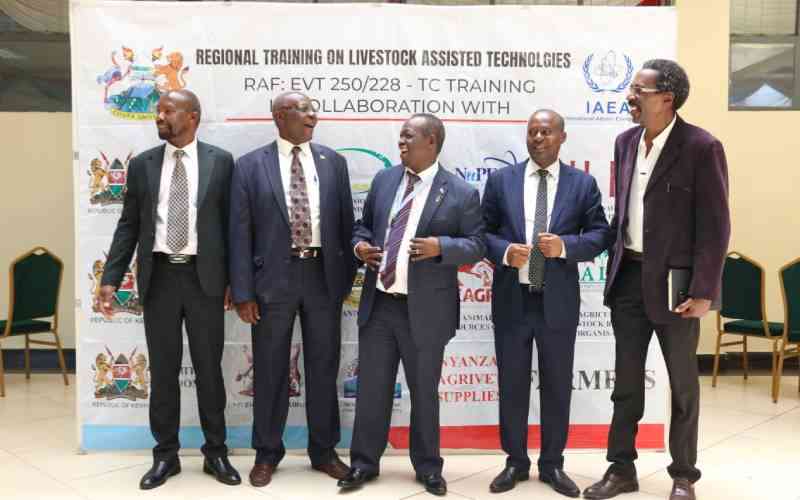
Chuka University champions livestock innovation for food security. [Courtesy]
Chuka University in Tharaka Nithi hosted the 3rd Summer School Regional Training on Assisted Reproductive Technologies in Livestock Breeding, in partnership with the International Atomic Energy Agency (IAEA) and others.
The event, themed "Advancing Livestock Reproduction for a Food-Secure Africa, attracted experts in research, livestock breeding, animal production, veterinary medicine, biotechnology and agricultural development from 28 African countries.
Speaking at the event, Vice Chancellor Prof Henry Mutembei and Council Chairman Prof David Serem rooted for collaborations in the sector, for the region to achieve food security.
Prof Serem said collaborations were key in addressing one of the continent's greatest challenges, ensuring sustainable food and nutritional security through science, innovation, and collaboration.
"Livestock (production) remains a critical pillar of Africa's economy. It supports millions of households through income generation, nutrition, employment, and trade. However, our livestock sector continues to face numerous challenges, including low reproductive efficiency, genetic limitations, climate variability, emerging diseases, and increasing demand for animal-source foods.
These challenges require innovative, science-driven solutions," Serem noted.
Prof Serem said assisted reproductive technologies, which include artificial insemination, embryo transfer, reproductive biotechnology, and advanced genetic improvement techniques, offer transformative opportunities to enhance livestock productivity while preserving valuable genetic resources.
"By strengthening reproductive efficiency and accelerating genetic improvement, these technologies will contribute significantly to improving food production, increasing farmers' incomes, enhancing resilience to climate change, and promoting sustainable agricultural development across Africa," he said.
The Summer School was more than just a training programme, as it also offered a platform for knowledge exchange, scientific collaboration, professional networking, and capacity building among Africa's leading researchers and practitioners.
"The ideas shared, partnerships established, and innovations demonstrated here will have a lasting impact far beyond this campus. As a university, we remain steadfast in our commitment to supporting research excellence, innovation, and partnerships that respond to societal needs.
Chuka University continues to position itself as a regional centre of excellence in agricultural research, biotechnology, and sustainable development," Serem added.
He said by hosting the continental programme they were reinforcing the varsity's strategic commitment to producing knowledge and innovations that directly contribute to national, regional, and global development agendas.
"We recognise that achieving food security in Africa cannot be accomplished by individual institutions or countries working in isolation. It demands strong partnerships among universities, research institutions, governments, development partners, and the private sector."
Stay informed. Subscribe to our newsletter
He said the training from the event will strengthen institutional capacities across the continent.
"More importantly, they will contribute to improving livestock productivity, enhancing breeding programmes, promoting sustainable food systems, and ultimately advancing Africa's food and nutrition security," he said.
Prof Mutembei said agriculture remained one of the institution's flagship areas of teaching, research and community engagement.
"Through our investment in research infrastructure, postgraduate training and international partnerships, the university is steadily positioning itself as a centre of excellence in agricultural sciences and biotechnology. We are proud that Chuka University continues to attract international confidence as a destination for scientific training and knowledge exchange," he said.
Mutembei said there was a need to build regional research collaborations that address common African livestock challenges.
"Knowledge grows when it is shared, innovation flourishes when experts collaborate, and Africa's future will be shaped by the scientific solutions we develop together. May this Summer School inspire new ideas, stronger partnerships and practical innovations that transform livestock production across our African continent and beyond," he said.







Subscribe to our newsletter and stay updated on the latest developments and special offers!







 join
join