×

The Standard e-Paper
Smart Minds Choose Us
 The Standard Group Plc is a
multi-media organization with investments in media platforms spanning newspaper
print operations, television, radio broadcasting, digital and online services. The
Standard Group is recognized as a leading multi-media house in Kenya with a key
influence in matters of national and international interest.
The Standard Group Plc is a
multi-media organization with investments in media platforms spanning newspaper
print operations, television, radio broadcasting, digital and online services. The
Standard Group is recognized as a leading multi-media house in Kenya with a key
influence in matters of national and international interest.

Audio By Vocalize
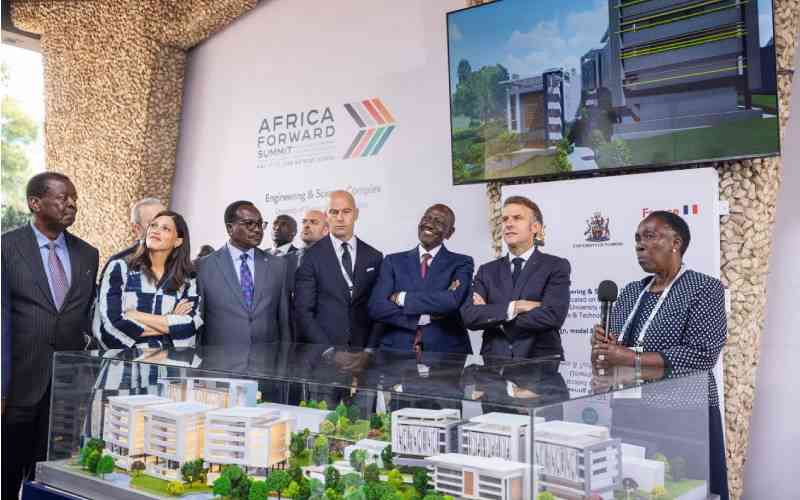
President William Ruto and French President Emmanuel Macron have unveiled an ambitious Kenya-France partnership targeting education reforms, youth employment and innovation as part of efforts to prepare Africa’s workforce for the digital economy.
The two leaders spoke during the “Africa Forward: Future Makers” session at the University of Nairobi, where they engaged students, innovators, entrepreneurs and creatives attending the ongoing Africa Forward Summit 2026.
The discussions focused on improving education outcomes, expanding technical and scientific training, strengthening innovation ecosystems and creating jobs for Africa’s rapidly growing youth population.
The session also saw the inauguration of a new Engineering and Science Complex at the university, developed through Kenya-France cooperation and described by the leaders as a transformative investment in Africa’s future workforce.
President Macron said Africa and Europe must move beyond traditional aid-based relations and instead pursue equal partnerships built on investment, education and technological advancement.
“Africa is succeeding. It is the youngest continent in the world and has the highest growth in the world. All that Africa needs is investments to be more sovereign and we want to be partners on an equal level,” Macron said.
The French leader said future cooperation would prioritise science, technology, engineering and mathematics (STEM), artificial intelligence, digital skills and innovation-driven training programmes for young people across the continent.
“You have to train more with investments to build STEM and AI capacities, partnerships with the best universities and educate more talent to ensure young people are trained here and help develop the continent,” he said.
Macron also urged Africa and Europe to jointly pursue technological sovereignty in areas such as artificial intelligence, digital infrastructure and energy systems, warning that Africa risks remaining a consumer rather than a producer of global technology.
“We have a common battle together. A lot of technological solutions today are made in the USA or China, and many of us remain consumers. We need to invest together so that Africa and Europe can build strategic autonomy,” he said.
He announced that France, working with private sector partners, would support the establishment of 50 digital centres across Africa under the “Digital Africa” programme, targeting the training of one million young people by 2030.
According to Macron, the programme will strengthen digital systems, expand training opportunities and support innovation ecosystems across African countries while deepening university partnerships between Africa and France through exchange programmes, joint research and technology transfer.
President Ruto said Kenya was implementing major reforms in the education sector to align learning with the demands of a modern, technology-driven economy.
“For us to be future-ready, infrastructure and knowledge are critical. We had to review our education system to make it competency-based because education was previously about cramming and academics only,” Ruto said.
He noted that Kenya had shifted towards experiential learning, with about 60 per cent of education content now focused on STEM subjects to equip learners with practical skills.
Stay informed. Subscribe to our newsletter
“We are investing heavily in education to ensure young people have the right skills and competencies to participate meaningfully in the digital economy,” he said.
University of Nairobi Chancellor Patrick Verkooijen said the initiative seeks to connect education, research and industry to address Africa’s growing youth unemployment challenge.
“Every month across Africa, one million young people enter the labour market, yet only a quarter secure formal employment,” he said.
He described the new engineering complex as a model for the continent.
“This initiative is not just for Nairobi or Kenya, it is a prototype for Africa. It will help create jobs, jobs, jobs for young Africans,” he said.
Youth participants at the summit called for greater access to funding, markets and digital opportunities, urging leaders to urgently tackle unemployment and digital inequality across the continent.





Subscribe to our newsletter and stay updated on the latest developments and special offers!