×

The Standard e-Paper
Stay Informed, Even Offline
 The Standard Group Plc is a
multi-media organization with investments in media platforms spanning newspaper
print operations, television, radio broadcasting, digital and online services. The
Standard Group is recognized as a leading multi-media house in Kenya with a key
influence in matters of national and international interest.
The Standard Group Plc is a
multi-media organization with investments in media platforms spanning newspaper
print operations, television, radio broadcasting, digital and online services. The
Standard Group is recognized as a leading multi-media house in Kenya with a key
influence in matters of national and international interest.

Audio By Vocalize
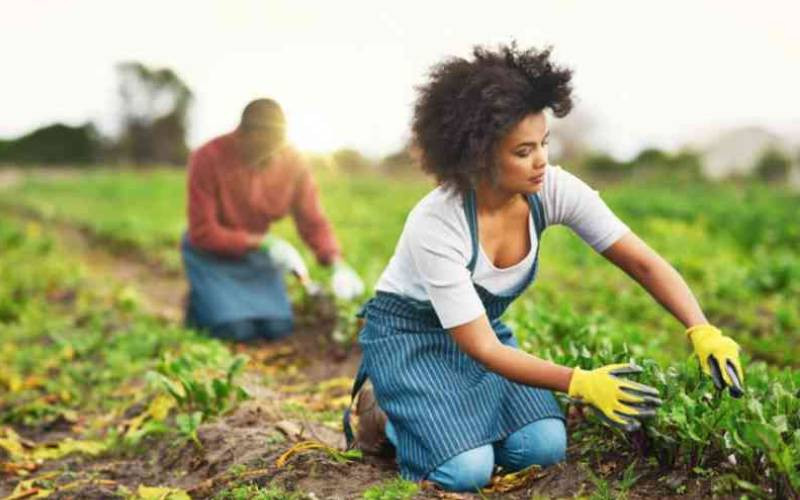
Women drive Kenya’s food production but face barriers in land, finance, and markets. [iStockphoto]
Women produce most of the food that feeds Kenyan households, yet they remain largely locked out of land ownership, finance and profitable markets.
The disparities were highlighted during discussions organised by the Kenya Editors Guild Press Club under the theme Women Cultivating Opportunity: Advancing Rights, Justice and Action for Women Farmers and Agripreneurs in Kenya.
Prof Mary Mbithi, team leader and economist at the University of Nairobi, said women account for between 70 and 80 per cent of the labour force in agriculture and produce about 60 to 80 per cent of the country’s food.
Despite this central role, most women remain in small-scale and informal farming systems that are rarely reflected in national economic statistics.
“Women only account for about 33 per cent of formal wage employment in the sector and hold less than 10 per cent of land titles,” she said. “When women do not control land, their ability to make decisions about what to produce, how much to produce and where to sell is limited.”
She added that women farmers often work longer hours than men because they combine farm labour with unpaid household responsibilities such as childcare, cooking and water collection.
Zubeida Kananu, president of the guild, reflected on the often unseen role women play in sustaining families and local food systems.
“There are thousands of women across Kenya quietly working, sacrificing and feeding a nation,” she said. “They may not always appear in headlines, yet their contribution is enormous. They are the backbone of our food system and our local economies.”
Lucy Wakiaga of the African Population and Health Research Centre pointed to wider structural inequalities that continue to affect women farmers across the country.
“Women participate heavily in agriculture. The real issue is the structure of inequality within these systems,” she said. “Land ownership, finance, education and technology access are still heavily gendered.”
Research findings show that between 75 and 93 per cent of agricultural land is not owned by women, while about 70 per cent of women have no land ownership at all.
Panellists also discussed the need to strengthen women’s economic rights within agricultural systems.
Tracy Lichuma from the Federation of Women Lawyers Kenya noted that Kenya already has legal provisions guaranteeing women equal rights to land and inheritance.
“Kenya already has strong legal provisions that support women’s land rights. The real challenge is implementation and accountability,” she said.
Stay informed. Subscribe to our newsletter
Chris Ojiewo, Inclusive Delivery Lead at the Consultative Group on International Agricultural Research, said agricultural innovation must be intentionally designed around the realities facing women farmers.
“Women farmers are often treated as beneficiaries rather than primary clients,” he said. “Digital tools, finance and market systems must be designed around their realities such as limited land ownership, time poverty and lower access to digital technology.”
He added that technology alone cannot address the inequalities facing women farmers.
“Access alone is not empowerment. Real empowerment happens when women can make decisions, reach reliable buyers, receive payments and retain control over their income.”
Speakers also emphasised the need for stronger digital inclusion, agricultural finance tailored for women and improved market access that allows women to move beyond low-return farmgate sales into higher value positions within agricultural value chains.
They noted that empowering women farmers is central to food security, economic growth and the long-term transformation of Kenya’s agricultural sector.





Subscribe to our newsletter and stay updated on the latest developments and special offers!






 join
join