
 The Standard Group Plc is a multi-media organization with investments in media
platforms spanning newspaper print
operations, television, radio broadcasting, digital and online services. The
Standard Group is recognized as a
leading multi-media house in Kenya with a key influence in matters of national
and international interest.
The Standard Group Plc is a multi-media organization with investments in media
platforms spanning newspaper print
operations, television, radio broadcasting, digital and online services. The
Standard Group is recognized as a
leading multi-media house in Kenya with a key influence in matters of national
and international interest.


Community health promoters during the malaria and hygiene sensitisation forum in Mwembe Kati village, Chonyi, Kilifi county. [File, Standard]
Kilifi county residents can now easily access routine medical services following the introduction of Health Information Points, a grassroots initiative designed to strengthen primary healthcare.
The HIPs have been set up in accessible locations, allowing residents to seek healthcare without travelling long distances to major hospitals.
HIPs model was developed by the North Coast Medical Training College (NCMTC) in the county, and it offers services of a Level One hospital.
County officials say the initiative has reduced congestion in top health facilities, with 19 counties visiting Kilifi to study how the model works.
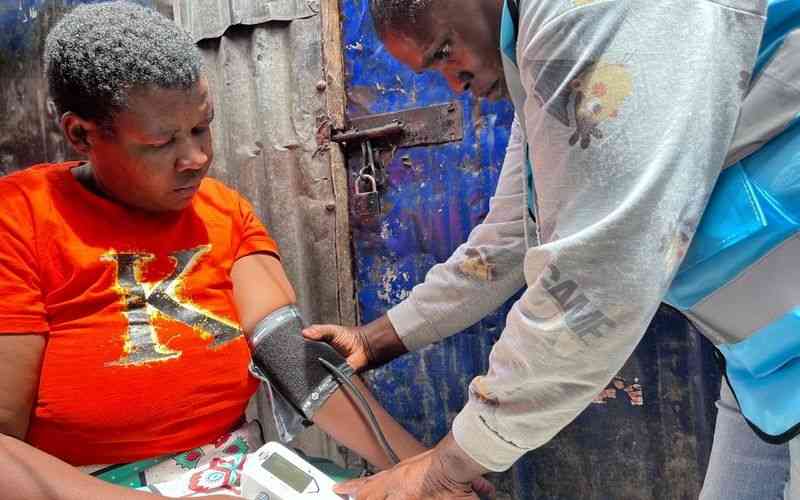
Services are delivered daily, with focus on prevention, early detection of illness and health education at the household level.
Already, the Community Health Promotion Fund (CHPF) has begun supporting the model in the Bomani area as part of efforts to strengthen primary healthcare under the Universal Health Coverage (UHC) agenda.
- Why quality standards matter in outpatient care
- Why SHA wants hospitals not dispensing drugs punished
- SHA hasn't paid healthcare centres Sh5.5b since February, say workers
Keep Reading
Kilifi County Primary Health Care Coordinator, Edward Mumbo, said seven primary healthcare networks have been established in the county to improve affordability and access.
Despite these gains, Mumbo said that the county still faces a shortage of family physicians, which is slowing the full realisation of PHC.
'If they were in sufficient numbers, each network would have its own physician. It would be beneficial, as more people would be reached,'' Mumbo said.
He regretted that low registration for Taifa Care, administered by the Social Health Authority, has left some residents exposed to high medical costs when referred to other facilities.
''As stakeholders, we must collaborate to strengthen PHC at the grassroots so residents can benefit and improve their well-being,'' he said.
He lauded support from stakeholders and called for more coordinated efforts to ensure communities have access to cost-effective healthcare services.
CHPF Programme Manager Addah Alela said data collected at the community level through such initiatives can strengthen health planning, improve outbreak detection and support trend analysis.
"That granular information at the grassroots is what will help us in health planning. It will help us identify outbreaks and track trends. By focusing on PHC, which is now at the heart of the community in advancing UHC, we can respond more effectively,'' said Alela.
CHPF is keen to utilise the HIPs model to strengthen PHC and advance UHC. If it achieves the desired outcomes, the model will be replicated in other counties.
''Our call to action is to extend this model elsewhere because it is effectively addressing community health challenges,'' she added.
NCMTC Managing Director Reuben Waswa said the college, located in a semi-rural setting, partnered with CHPF to bring services closer to residents through simple but functional structures.
Waswa described HIPs as simple tent-like structures that nonetheless play a critical role in community health service delivery.
''We hope that once we promote it, it will be adopted in other areas because it addresses many of the challenges facing the current health system,'' said Waswa.
For instance, it reduces the distance people travel to access health information. Information is vital because medicine alone cures but does not necessarily create health," he added.
Wycliff Ogenya from the Ministry of Health said the model supports early diagnosis, disease prevention and health promotion, adding that community participation is central to its design.
"It clearly demonstrates that community participation and service delivery are at the centre of this intervention, enhancing primary health care," he said, adding that the innovation should be scaled up.








 join
join