×

The Standard e-Paper
Truth Without Fear
 The Standard Group Plc is a multi-media organization with investments in media
platforms spanning newspaper print operations, television, radio broadcasting,
digital and online services. The Standard Group is recognized as a leading
multi-media house in Kenya with a key influence in matters of national and
international interest.
The Standard Group Plc is a multi-media organization with investments in media
platforms spanning newspaper print operations, television, radio broadcasting,
digital and online services. The Standard Group is recognized as a leading
multi-media house in Kenya with a key influence in matters of national and
international interest.

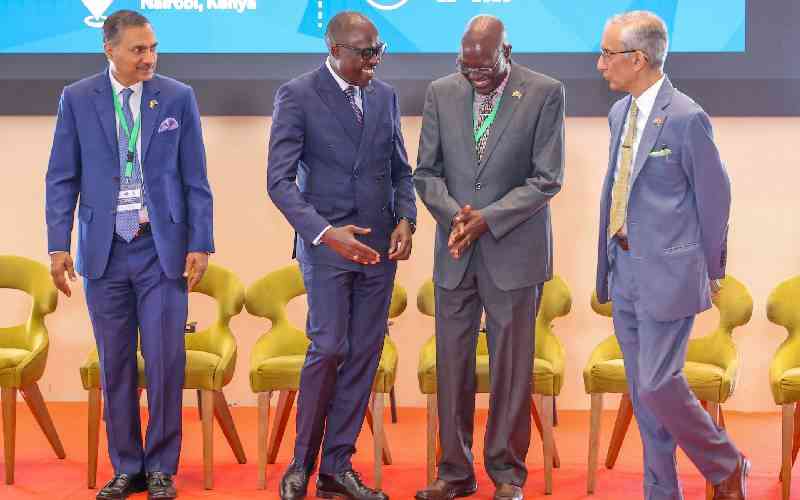
From left: High Commissioner of India Adarsh Swaika, Foreign Affairs PS Korir Singoei, GLOCEPS Council of Advisors Chairperson Wilson Boinett, Amb Rahul Chhabra during the symposium in Nairobi, on January 22, 2026. [Wilberforce Okwiri, Standard]
Kenya and India are rethinking the future of their bilateral relationship as shifting global power dynamics, economic uncertainty and security pressures push long-standing partners to move beyond tradition into more strategic cooperation.
Those dynamics and pathways were at the centre of a high-level symposium on reshaping India–Kenya cooperation in the 21st century, where policymakers and diplomats examined how the two countries can recalibrate their partnership to remain relevant, resilient and transformative in a rapidly changing geopolitical landscape.
Speaking at the symposium, Foreign Affairs Principal Secretary Korir Sing’oei, said the international system is undergoing deep disruption, forcing nations to redefine interests and partnerships. He described the moment as critical for Kenya and India as they approach 63 years of diplomatic relations.
“This symposium invites us not merely to celebrate a long-standing relationship, but to critically examine how we reposition this partnership to remain relevant, strategic, and transformative in a rapidly changing world,” Dr Sing’oei said.
The symposium was convened by the Global Centre for Policy and Strategy (Gloseps) in collaboration with the High Commission of India in Nairobi. It brought together senior government officials, diplomats, policy experts and development partners to explore new areas of cooperation across trade, security, technology, health and education.
Sing’Oei traced Kenya–India relations to deep historical ties shaped by migration, trade and shared democratic values. He noted that Indian traders, artisans and professionals have been part of East Africa’s social and economic fabric for centuries, contributing to commerce, medicine, education and public service.
“These historic ties, reinforced by shared values of democracy and the rule of law, sustain our diplomatic engagement and economic cooperation,” he said. “However, our relationship must evolve beyond what was to a forward-looking strategic partnership.”
He pointed to the construction of the Kenya-Uganda railway as an early symbol of cooperation, built with the labour of thousands of Indian workers, many of whom stayed on and helped build Kenya’s institutions. That legacy, he said, should inform how both countries think about future collaboration.
Sing’Oei argued that the next phase of cooperation should prioritise investment-led industrial growth rather than trade alone.
He highlighted agri-processing as one sector where complementary strengths could support value addition and shared industrial development.
“Opportunity lies in shifting from trade-based relations towards investment-led industrial and value-added operations,” Sing’Oei said.
Security and maritime cooperation also featured prominently, with Kenya and India sharing interests in a secure and resilient Indian Ocean region. Sing’Oei said stability in maritime domains is essential for global trade, climate resilience and regional peace amid growing geopolitical fragmentation.
Adarsh Swaika, the High Commissioner of India to Kenya and Permanent Representative to the United Nations Environment Programme and the United Nations Human Settlements Programme, underscored the strength of the bilateral relationship, citing growing trade ties and people-to-people connections.
Stay informed. Subscribe to our newsletter
“The evidence of our partnership strength is already written in undeniable terms, with 3.35 billion dollars in bilateral trade and a diaspora of over 80,000 people building innovation and community,” Dr Swaika said. “Today we move from celebration to construction.”
Swaika said the future of India–Kenya relations lies in strategic collaboration and economic cooperation anchored on digital infrastructure, health security, and sustainable investment. He noted that India’s experience in digital public infrastructure offers lessons that could support Kenya’s digital ambitions while respecting data sovereignty.
Wilson Boinett, Chairperson of the Gloseps Council of Advisors described the symposium as a platform for moving dialogue into action. He said think tanks play a critical role in translating policy ideas into practical recommendations that governments can implement.
“This forum is designed to challenge orthodoxies and produce actionable insights that will define the next chapter of Kenya–India relations,” Boinett said.
Dr Kennedy Asembo, Gloseps Executive Director said the symposium aims to generate policy-relevant outcomes, including a policy brief and research outputs that can inform future diplomacy and cooperation frameworks between Africa and Asia.
The discussions were organised around two thematic sessions. The first focused on strategic collaboration in a changing Indo-Pacific and Eastern Africa landscape. Participants examined defence and maritime security, regional integration, renewable energy, rare earth minerals and the role of the Indian diaspora in sustainable development.
The second session explored economic collaboration in a changing global environment, with attention to trade and investment, digital public infrastructure, pharmaceutical manufacturing, supply chains, education and skills development. Speakers emphasised the need to align Kenya’s connectivity and human capital goals with India’s technological and manufacturing strengths.
The speakers agreed that Kenya and India are well positioned to model a new form of South–South cooperation grounded in shared interests, mutual respect and long-term strategic thinking.

Subscribe to our newsletter and stay updated on the latest developments and special offers!








 join
join