×

The Standard e-Paper
Smart Minds Choose Us
 The Standard Group Plc is a
multi-media organization with investments in media platforms spanning newspaper
print operations, television, radio broadcasting, digital and online services. The
Standard Group is recognized as a leading multi-media house in Kenya with a key
influence in matters of national and international interest.
The Standard Group Plc is a
multi-media organization with investments in media platforms spanning newspaper
print operations, television, radio broadcasting, digital and online services. The
Standard Group is recognized as a leading multi-media house in Kenya with a key
influence in matters of national and international interest.

Audio By Vocalize
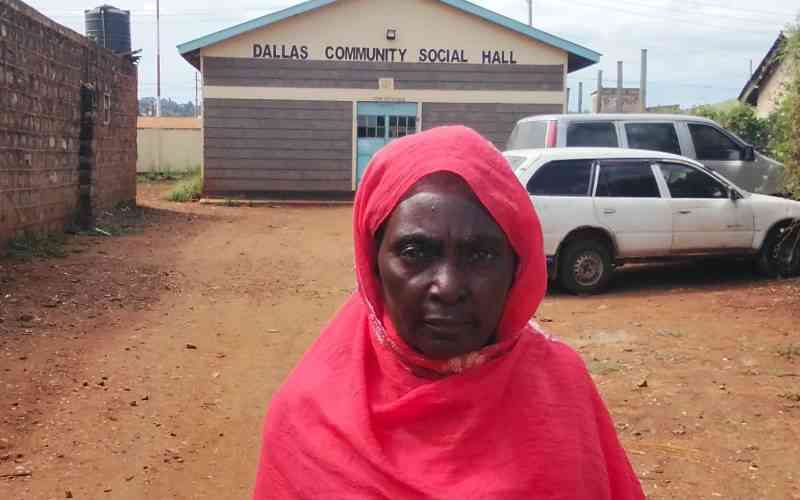
A 76-year-old widow is awaiting the implementation of a court order for the demolition of Dallas Social Hall in Embu, whose construction on a public access road leading to her home was declared illegal and unlawful by the Environment and Land Court.
Zainabu Ramadhan Njoka, who owns land parcel number Gaturi/Githimu/2487 in Dallas Estate, Kirimari Ward, says the construction has interfered with her access to her home, forcing her to seek passage through a neighbour’s property.
The dispute dates back to 2017 and In 2023, she took her grievances directly to Embu Governor Cecily Mbarire through a notice published in a national newspaper, appealing for intervention.
“Your Excellency, while I am forced to beg for passage through my neighbour's property to reach my house in my sunset days, the schemers and executors of this act of impunity are enjoying unrestricted access to their homes,” she wrote.
Zainabu said it was unfair that the county continued collecting land rates from her while making it difficult for her to access her own home.
The dispute eventually ended up in court, where Zainabu, through her son Abdulkarim Njeru, and another affected property owner, Sammy Kithaka, challenged the construction. They sued the county government, the Director of Physical Planning and Survey, and the Attorney-General.
Their initial case was unsuccessful, with the trial court upholding the county's position on the construction. They subsequently appealed to the Environment and Land Court in Embu in 2025.
In the appeal, Njeru and Kithaka argued that the trial magistrate had erred in finding that they lacked the capacity to enforce rights relating to parcels Gaturi/Githimu/2487, 2490 and 2494, which were registered in the name of Njeru's late father, Ramadhan Njoka Mwando, when the suit was filed.
They also faulted the magistrate for failing to properly consider documentary evidence that they said established that a public access road had been blocked.
The appellants argued that Embu County Government had erected a permanent structure on a 12-metre-wide access road serving parcels 2494 and 2487 on one side and parcels 2495 and 2486 on the other.
They maintained that the road was clearly marked on the Registry Index Map (RIM) for the Gaturi/Githimu survey area.
They asked the court to overturn the magistrate's decision, declare the construction unlawful and issue an order for the demolition of the structure.
The county denied the allegations, maintaining that the construction had been undertaken lawfully. It urged the court not to grant the demolition orders.
The Attorney-General's office also opposed the appeal, arguing that if a social hall had been constructed, it stood outside the access road and had been built in the public interest and in accordance with the law.
In dismissing the original suit, the magistrate had found that Njeru had failed to prove his case, holding that his entitlement to inherit parcel one of the affected parcels did not give him the capacity to enforce rights over parcels 2486, 2490, 2494 and 2495.
Stay informed. Subscribe to our newsletter
The magistrate also faulted the appellants for failing to produce documentation from the National Construction Authority (NCA) to support their allegations concerning the allegedly unlawful construction. The court further noted that they had not called witnesses from the NCA and the National Land Commission (NLC).
On appeal, Njeru maintained that he was the administrator of his late father's estate and therefore had the legal capacity to pursue the case.
He also told the court that documentary evidence had been produced, including an NCA report and correspondence from the NLC confirming the public nature of the road.
In her judgment, Justice Kosi Bor found that Njeru had presented letters of complaint submitted to the NCA in 2017, alongside correspondence from the county indicating that the land occupied by Dallas Social Hall was a road reserve.
The court was also told that the Director of Physical Planning had referred to correspondence indicating that a process was underway to change the use of public land reserved for one purpose to another.
Among the evidence presented by the appellants was an NCA report dated 2017, which they said showed that the hall had been constructed without architectural drawings and a compliance certificate demonstrating that the construction had been registered with the authority.
They also produced a 2017 NLC report confirming that the road was not available for allocation.
Justice Bor observed that the Registry Index Map showed that the area occupied by the social hall bordered parcels 2495 and 2486 on one side and parcels 2484 and 2487 on the other side.
The judge found no evidence that notice had been issued to affected stakeholders before the road was closed and converted for another public use.
“The AG’s contention that the 2nd Respondent confirmed that due process was followed before the construction of the social hall lacks basis since none of the Respondents tendered any evidence before the trial court,” the judge stated.
She further observed that correspondence from the NCA, NLC and the county showed that stakeholders likely to be affected by the closure of the road had not been involved in the decision to construct the hall.
Justice Bor consequently allowed the appeal, set aside the judgment in Embu Chief Magistrate's Court Environment and Land Case No. 87 of 2018, and allowed prayers one and two of the plaint dated August 9, 2017.
The appellants were also awarded the costs of both the appeal and the original suit, to be borne by the respondents.
Njeru and Kithaka subsequently obtained a demolition decree dated May 14, 2026. However, the structure was still standing at the time of writing.
County road reserve acknowledgement
In a related development, a letter dated May 15, 2023, addressed to Governor Mbarire and signed by Raymond Kinyua, the County Executive Committee Member for Lands, Mining, Housing, Physical Planning and Urban Development, appears to support the appellants' position.
The letter followed a site visit by the department to establish the circumstances surrounding the construction.
“It was established that Dallas Social Hall sits on a road reserve that serves parcels Gaturi/Githimu/2493 and 2487 on one side and Gaturi/Githimu/2495 and 2486 on the other side,” the letter stated.
The correspondence raises further questions about the county's position on the disputed property, particularly in light of the subsequent court judgment declaring the construction unlawful.
IEBC search for alternative facility
The Independent Electoral and Boundaries Commission (IEBC) has also acknowledged using Dallas Social Hall as a voter registration centre.
In May 2026, IEBC Acting Chief Executive Officer Moses Sunkuli said the commission had begun looking for an alternative facility following receipt of information about the dispute and the court order.
“However, following the information provided and attached court order, the Commission has commenced the process of identifying a suitable alternative facility that can effectively serve as a registration centre and polling station for the affected electoral area,” Sunkuli said.
The commission's response signalled its intention to identify another facility for electoral services in the affected area.
Auditor-General questions
Further concerns about the management and construction of Dallas Social Hall emerged in the Auditor-General's report for the 2024/2025 financial year.
The report noted that Embu County Government operated five social halls, two of which were being used by IEBC and Talent Academy, generating revenue of Sh120,000 and Sh206,000 respectively.
However, revenue generated by the remaining three halls was not deposited into the county revenue account but was instead used by communities at source, contrary to the Public Finance Management (County Governments) Regulations, 2015.
The report raised concerns about the accountability of the revenue collected from the three halls, noting that the funds were managed by communities and that no formal handover had taken place after construction.
It also highlighted concerns over the approvals for Dallas Social Hall, stating that the facility had been constructed without the necessary approvals from the county and national governments.
“Further, physical inspection conducted on one of the social halls revealed that it was constructed on a road reserve,” the report stated.
The audit further raised concerns that revenue from the facilities had been channelled into a private bank account rather than the county's official revenue account.
These findings add another dimension to the controversy surrounding Dallas Social Hall, which now involves questions of public land, compliance with court orders, construction approvals and the accountability of public revenue.
For Zainabu, however, the immediate concern remains access to her home and the implementation of the court's decision.
At 76, she is still waiting for the demolition decree to be enforced and the access road restored.








Subscribe to our newsletter and stay updated on the latest developments and special offers!








 join
join