
 The Standard Group Plc is a multi-media organization with investments in media
platforms spanning newspaper print
operations, television, radio broadcasting, digital and online services. The
Standard Group is recognized as a
leading multi-media house in Kenya with a key influence in matters of national
and international interest.
The Standard Group Plc is a multi-media organization with investments in media
platforms spanning newspaper print
operations, television, radio broadcasting, digital and online services. The
Standard Group is recognized as a
leading multi-media house in Kenya with a key influence in matters of national
and international interest.

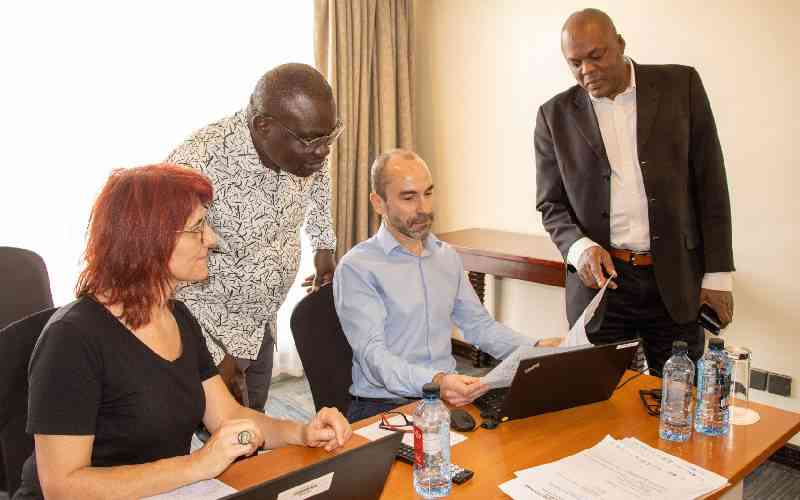
Experts Oliver Lareynie and Delphine Pellegrini, who led the workshop on radioactive waste wanagement, and senior KNRA officials Erick Ngotho (right) and Michale Atogo. [Courtesy]
As climate change vagaries intensify across Kenya and the wider region, attention is rapidly shifting to sustainable waste management.
Experts now warn that mismanaged waste significantly contributes to greenhouse gas emissions, further worsening climate impacts. In response, counties are adopting circular economy practices such as recycling, composting and proper handling of hazardous waste.
And as the debate over waste management grows, government agencies insist that public involvement is crucial to reducing landfill emissions and curbing pollution.
With mounting climate pressures, integrating sustainable waste strategies is now viewed not just as an environmental necessity but also as a public health concern.
Last week, the government, through the Kenya Nuclear Regulatory Authority (KNRA), held a week-long workshop on Radioactive Waste Management to deepen policy dialogue and stakeholder engagement. The workshop, under the European Instrument for International Nuclear Safety Cooperation (EU-INSC) in Nairobi, focused on waste characterisation, waste conditioning and worker safety in storage facilities.
KNRA Senior Principal Nuclear Inspector Eric Ngotho presented Kenya’s current radioactive waste inventory, regulatory requirements and management practices. “This is an opportunity for us as a country to learn and to put our best foot forward in policy formulation and decision-making related to radioactive waste management,” Mr Ngotho said.
- Eat to live: How your plate could save the planet
- Peer review begins amid push for UHC and nuclear programme
- Land acquisition deals for carbon credits raise transparency concern, report warns
- Nuclear power can light up Kenya but radioactive waste disposal poses risks
Keep Reading
As part of the knowledge exchange, experts Oliver Lareynie and Delphine Pellegrini from the French regulator ASNR, joined participants in touring the Central Radioactive Waste Processing Facility (CRWPF) in Oloolua, Kajiado County.
Established in 2010 and commissioned in 2022 with support from international partners, the facility serves as the interim storage and processing centre for radioactive waste generated in Kenya. The nuclear regulator hopes that upon completion of the remaining phases, the facility will be a significant shot in the arm for Kenya in the management of radioactive waste.
Last year, the Departmental Committee of Parliament on Health visited Oloolua to ascertain its progress. KNRA Director General James Keter called for more resources to beef up operations in the facility.
KNRA Deputy Director for Licensing Michael Atogo said Kenya is moving in the right direction but noted that “stakeholders must work together to ensure the country embraces sustainable radioactive waste management” as it advances towards a nuclear power programme.
Kenya generates between 3,000 and 4,000 tonnes of waste daily, with Nairobi alone contributing 2,000 to 2,500 tonnes, including potentially radioactive materials. Most of the radioactive waste handled at the facility comes from medical centres using nuclear technology for diagnosis and treatment, agricultural research institutions, industrial processes and major construction works.
Experts say that while the use of radioactive sources continues to grow, ensuring proper waste management remains challenging, particularly due to the risk of such sources slipping out of regulatory control and posing threats to public safety and security.





 join
join